
Three Game 7s later, we have our eight first-round winners from the 2026 NBA Playoffs. There’s hardly time to rest; the NBA’s second round begins Monday. But before that happens, let’s revisit the best moments of this year’s first round with awards I’ve invented to dole out to various players and moments that deserve praise and acknowledgement.
VOTE IN OUR ‘STATE OF THE NBA’ FAN SURVEY
The first round’s best game: The 76ers’ Game 7
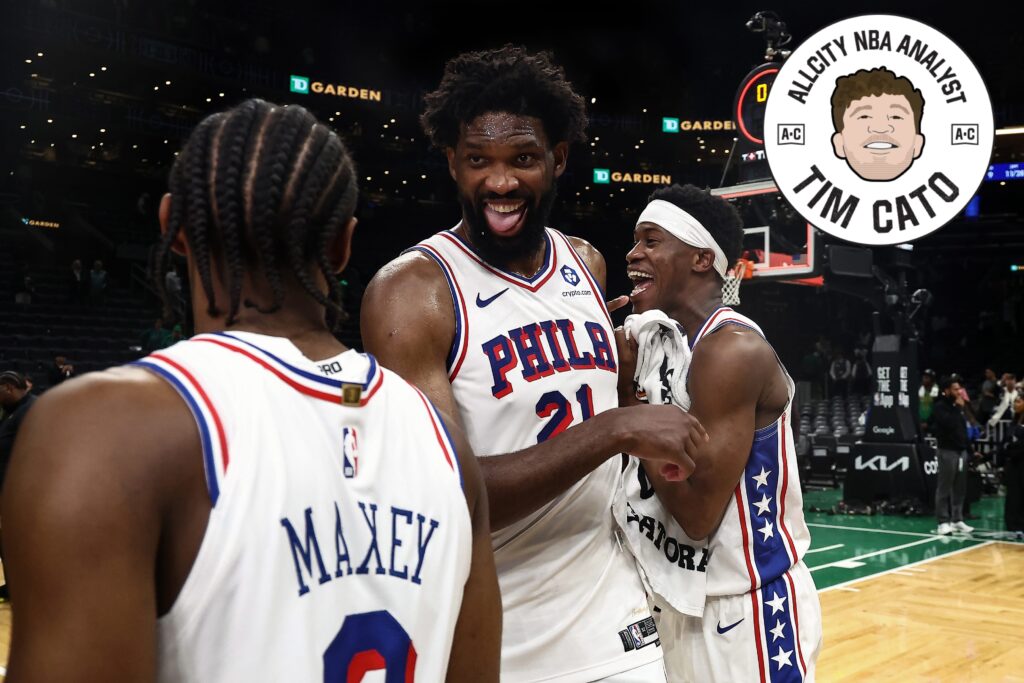
It has to be the Philadelphia 76ers’ Game 7 win against the Boston Celtics, a narrative-rich upset no one anticipated, most certainly not with a dramatic Joel Embiid return from emergency surgery that decisively skewed the matchup advantage in Philadelphia’s direction. They said I was mad when I predicted, albeit dead last in an “increasingly strong predictions” story, the 76ers could win the NBA Finals before this season began. I didn’t think that championship-esque level wouldn’t be reached until Philadelphia was down 3-1 in the first round, I’ll admit that. But Philadelphia’s comeback was peak postseason insanity. The Game 7 matched it, too.
I’m sure PHLY fans have watched this dozens of times since Saturday. This is your sign to cue it up once more.
I’ll most remember Tyrese Maxey’s two blow-by layups, ones he still had the legs for in his 43rd and 44th minutes of his third Game 7, from the game itself. But, like many others, what’s most notable is how dramatically Joel Embiid erased his postseason demons against Boston. To do it in this manner, playing weeks after a surgery that would sideline normal folks for months, after injury narratives have been irreversibly entwined with his career, emerging as the best player on the court while his team won this series’ final three games … this was, without question, a postseason moment for Embiid that has been long coming and beyond earned.
The Kendrick-at-the-Super-Bowl award: Jaden McDaniels
You cannot back up your shit talk any louder than Jaden McDaniels did this first round. “They’re all bad defenders,” he said after Game 2. “Go after Jokic, Jamal, all the bad defenders. Tim Hardaway, Cam Johnson, Aaron Gordon, the whole team, just go at them.” McDaniels named names, rattling off Denver’s entire rotation like Kendrick Lamar did rappers on his “Control” verse, friendly(-ish) barbs at those he saw as peer rivals.
McDaniels’ verbal challenge to his opponents had far less respect, but respect’s overrated in competitive sports, especially if it’s true, and it was. McDaniels made sure to drive home that point in the four games that followed, averaging more than 19 points while converting nearly 60 percent of his 2s. He scored a career-high 32 points in the series-clinching Game 6, burying Denver himself without Anthony Edwards and two more starters available for that game. By then, McDaniels had transitioned to something more akin to the shit-talking apex: Kendrick flaunting his Drake diss track at last year’s Super Bowl, coronating how crushingly he’d won his beef with the Canadian shooting guard pop star.
They’re all bad defenders, indeed.
The book-travel-at-halftime award: The Knicks’ 62-19 lead
In 2022, I was at the Chris Paul hits a huge three to cut the lead down to 42 game, one of recent postseason history’s more stunning moments. The Phoenix Suns had been the league’s No. 1 seed; they’d appeared in the finals just one season prior. Then, before that Game 7’s second quarter even ended, everyone knew their season was over. It was like attending someone’s funeral where the deceased’s wishes clearly hadn’t been respected, like if sad Eric Clapton songs were playing for someone who had been the bassist in a punk band. We know they’re dead; what’s happening now just feels gauche.
I did two things at halftime, first writing this tweet:
That vital task out of the way, I booked my flight and hotel to San Francisco, now knowing that the Mavericks‘ season, and mine, would continue there in several days for the conference finals. I had saved reservations that afternoon, worried I’d only have time to click two or three buttons in the post-game frenzy. I could’ve, it turned out, compared rates for an hour as that game concluded.
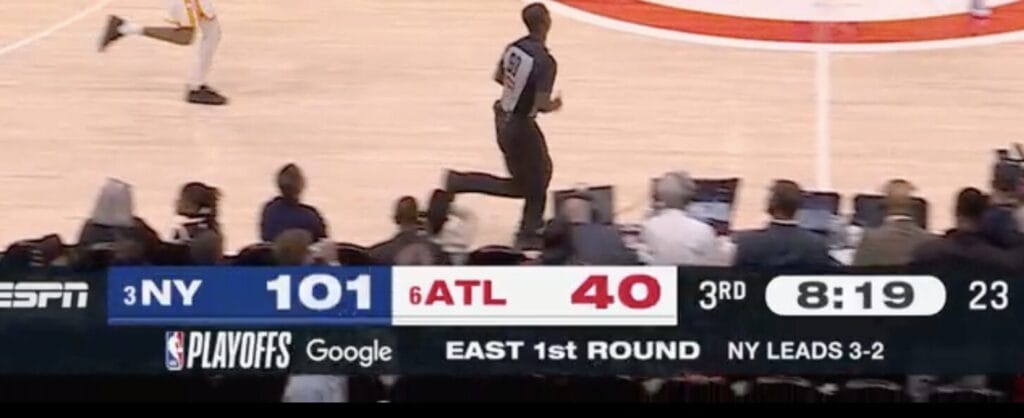
In Game 6, when the New York Knicks built a 62-19 lead over the Atlanta Hawks not even halfway through the second quarter, I have to imagine media members at that game were doing the same thing. In the second half, the lead even reached 61 points: 99-38 and then 101-40 before ending as a mere 51-point series-clinching win. I like the second score a lot, the 101-40 one. It’s nice, clean, round numbers where the sheer shame of that Hawks performance can be easily calculated.
Atlanta had an encouraging season, specifically once it found its identity in the season’s second half, and a respectable first-round series against New York if you focus only on the 2-1 scare that had Knicks fans teetering on the emotional crashouts. But the Hawks nearly threw away all that goodwill with an ending this nauseous. This defeat had the type of stomach bile that makes you swear off the culprit food for life. Hell, the Hawks themselves could’ve been the ones booking flights at halftime to get away from the crime scene.
They should do their best not to dwell on it, but I fear this screenshot may live forever.
The 16-game-player emergence award: Collin Murray-Boyles
Draymond Green perfected the 16-game player: Someone who can be so frustrating in the regular season, sometimes for his inattentiveness and sometimes for his antics, who’s skillset won’t usually earn him All-Star nods or gaudy statistics, but a player, once the calendar turns to the postseason, that does everything you need to win. I don’t wish all those extraneous Draymondisms onto anyone, but there’s another player in Toronto who looked astonishingly similar to Green’s on-court genius in the first round even if it came in defeat.
Collin Murray-Boyles became the 13th rookie this century to average at least 14 points across seven or more playoff games. Among those 12, none had averaged fewer points (8.5) than Murray-Boyles had this regular season. Against the Cleveland Cavaliers, however, Murray-Boyles averaged: 14.4 points, 6.4 rebounds, 2.4 assists, 1.3 steals, 1.1 blocks while shooting almost 66 percent from the field.
Look at these two defensive possessions: Murray-Boyles first harasses Evan Mobley into a turnover; in the second, he tracks Donovan Mitchell for nine dribbles before getting fingertips on his pull-up jumper.
That’s Green-esque flexibility, both literally in how he glides across the court but also his versatility, taking on two of Cleveland’s most differently shaped players and forcing two defensive stops. It was a brilliant postseason debut, one where the 6-foot-7 Murray-Boyles, who plays bigger than his height, often looked like one of those 16-game scheme-wrecking defenders, the type of player you’ll find on every special defensive unit.
Scottie Barnes was even more dominant; not only should he be universally seen as a top-20 player, but we really should be asking how far into the teens he should climb. His two-way play against Cleveland was that spectacular. (I only count 11 names that obviously clear his.) By pairing Murray-Boyles with him, Toronto has now created an identity. These two checkpoints of athletic superiority, not easily passable even with TSA Global Entry, have given the Raptors fangs again.
The safety-vest-gets-you-anywhere award: Dillon Brooks
Dillon Brooks isn’t a superstar. That’s an obvious fact, one you could never convince Dillon Brooks of. Brooks swaggers around basketball like a man who just strolled into a Tommy Wright III concert with a reflective vest and a toolkit rather than a ticket. (OK, I’ve been to a Tommy Wright III concert and its security was not that tight; insert any other Memphis-born artist with more fame.) Specifically, Brooks carried himself this season as a lead scorer, a cosplay at times indistinguishable from the real thing. In the regular season, sure, his 54 percent True Shooting was a necessary addendum to his first 20-point-scoring season.
Against the Oklahoma City Thunder, however, Brooks’ act even fooled the league’s best defense: He averaged 26 points while hitting nearly 44 percent of his 3s and 47 percent of his 2s. In the Thunder’s as-expected four-game sweep, Shai Gilgeous-Alexander attempted 21 mid-range jumpers and made 11 of them. Brooks took 16 while making 10. It’s an infinite confidence Brooks has, which elevated Phoenix’s season into something delightful and surprising despite its rote ending.
The best ‘Jrue’d them’ award: VJ Edgecombe
Please look at VJ Edgecombe’s unreal defense against Jaylen Brown on this play:
Edgecombe has been preposterously poised for a 20-year-old rookie; in the four wins Philadelphia used to knock out the Boston Celtics, Edgecombe averaged nearly 16 points on 65.2 percent True Shooting. But even in the defeats, games where his shooting went cold, Edgecombe’s impact never did. It’s his defense that earns credit for that, and it shows up in Philadelphia’s on-off numbers: Edgecombe played in 269 of the 336 possible minutes, and the 76ers were plus-23 in his minutes. Without him, they were outscored by 43. Both numbers were team highs.
That back-to-the-defender technique, if you can even call it technique since no trainer would coach that, is something I’ve only seen from two players. Jrue Holiday is most famous for it, as seen below, but Kris Dunn has often corralled opponents in the same manner over the past couple seasons.
Holiday and Dunn have been two of the league’s best point-of-attack defenders, and it’s simply astonishing to see this 20-year-old rookie mimic them this easily.
The I-accidentally-became-important-at-my-job award: Amen Thompson
Thompson’s position isn’t point guard. It’s Thompson, a unique position we’ve only labelled to two more players: his brother Ausar, of course, and, interestingly, Dyson Daniels. (Matisse Thybulle has been expelled for hitting a few too many 3s.) But when the Rockets chose not to backfill for Fred VanVleet after his season-ending injury before this year began, Thompson was thrust from his Thompson position into the point guard role, for better and worse. Once Kevin Durant was ruled out for Game 1, which limited him to just one game in Houston’s first-round defeat, Thompson became the team’s only player who could receive the ball on the perimeter and still create shots inside the arc and for his teammates. It showed.
Thompson played all but 24 minutes for an average of 44 in the first round (when discounting garbage time), and Houston outscored Los Angeles by seven when he was on the court. The Thompson-less minutes, however, were ones the Rockets lost by 22. That net point differential equates to 59.5: Houston played 59.5 points per 100 possessions worse when Thompson sat. It was 76-54, precisely, which was pitiful stuff from a team that has blame to spread to nearly every corner of the franchise after this bizarre season. But Thompson, performing heroically despite playing out of his preferred Thompson position, should feel it the least.
The statline-we-won’t-remember award: Shai’s 15-of-18 shooting
We won’t remember Gilgeous-Alexander’s Game 3. We don’t really need to. Gilgeous-Alexander has ascended beyond our need to care about what he does, however marvelous, in a ho-hum first-round sweep. But Gilgeous-Alexander’s Game 3 line, once more for posterity: 42 points, 18 shots taken, 15 shots made. It’s still not Dirk Nowitzki scoring 48, against Oklahoma City in 2011 in fact, while shooting 12-of-15 from the floor. But it was a ridiculous performance, one I will lose all memory of by tomorrow, probably.
The mother-says-you’ll-hurt-yourself award: Wemby’s spin move
Moms know. From what I remember as a child, I was sometimes so stubbornly set on injuring myself there was no stopping it. “You’re going to hurt yourself,” my mom told me, which usually happened minutes before I hurt myself. I’m sure some of y’all can relate to this. Call it an exasperated motherly premonition; give it a couple years, and maybe moms can make money betting the impending scraps and falls of their children who won’t listen on Kalshi.
Anyway, I was that mother when Wembanyama started doing way too much in Game 1’s fourth quarter. It was this move, specifically, that concerned me.
Well, it was this same spin move that caused his Game 2 concussion. He missed only one game, which San Antonio won anyway; it’s better for basketball we get to see him out there. But it was predictable that spin move would lead to nothing good.
Most annoying summer discourse award: Nikola Jokić’s legacy
It’s a warranted discussion, make no mistake. To the extent any sports discourse matters, it’s to argue about which of these tallboys are the best ones. (Can’t go wrong with a 24-ounce Montucky Cold Snack.) Because Jokić lost in such humiliating fashion, even if his Game 6 performance will probably be remembered much worse than it actually was, he should earn an offseason examination for where he currently ranks amongst the all-time greats. This is sports discourse’s comfort food; it’s second only to sitting around naming dudes we remember from the past. Jokić’s performances earned himself some slander. That’s just the reality.
But we know it’s going to produce takes dumber than we can even imagine. Enjoy what innocence we have left until then.
Tim Cato is ALLCITY’s national NBA writer currently based in Dallas. He can be reached at tcato@alldlls.com or on X at @tim_cato.