

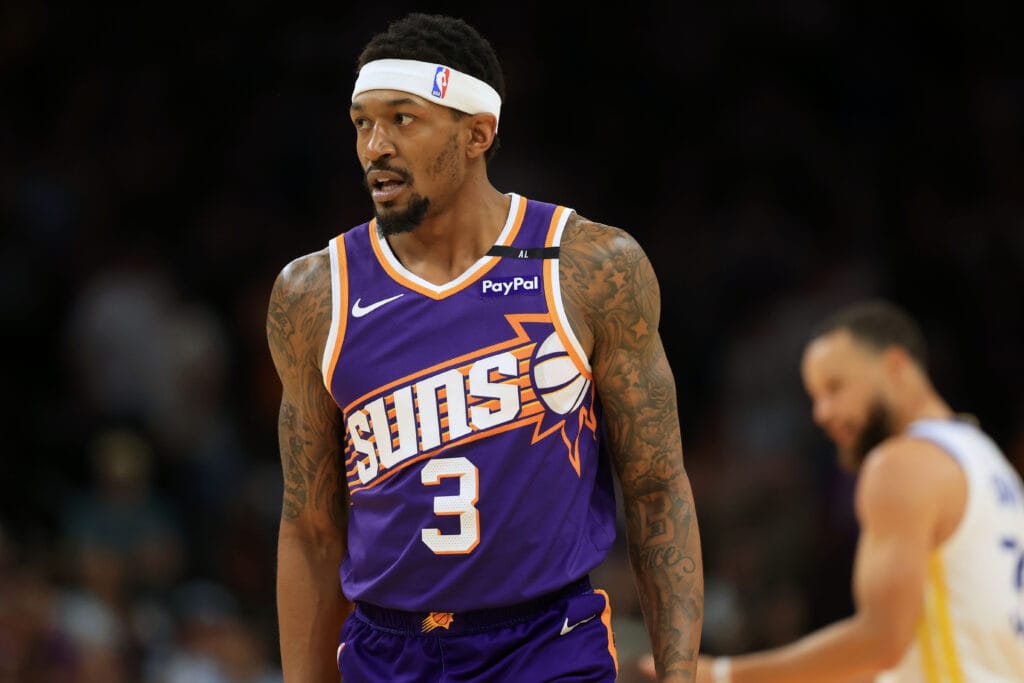
From a financial and roster-building standpoint, the Phoenix Suns had a Bradley Beal problem. On Wednesday, they opted for a buyout, which means a Bradley Beal waive-and-stretch will likely become their solution to that problem. The Suns have until Aug. 30 to officially pull the trigger, but multiple Suns sources who spoke with PHNX Sports said that is “99 percent” likely to be the path.
Like any other bold move, this path comes with some obvious cons…and a few pros that aren’t likely to draw as much attention.
With two years and $110.8 million left on Beal’s contract, a source said the two sides were able to agree on a $13.82 million buyout, with Beal sacrificing that amount to become a free agent (though it’s worth that noting based on the cap math, that figure should wind up closer to $13.9 million). The Suns would then take the remaining $96.9 million he’s owed and spread his payout over the next five years, which means Beal will be on the books for about $19.4 million per year over that five-year span.
So why did the Suns choose a Bradley Beal waive-and-stretch, rather than just ride out the next two years with Beal earning $53.7 million this season, plus a $57.1 million player option for 2026-27? Why was this path more preferable for the Suns compared to buying him out and simply containing the damage to the next two seasons? And how did the two sides agree on that $96.9 million figure in the first place?
Let’s dive into the details to figure out the reasoning behind this move, as well as the positives and negatives that come with it.
How the Suns settled on $96.9 million for the Bradley Beal waive-and-stretch
In order to enact a Bradley Beal waive-and-stretch (or the “stretch provision,” as it’s officially called), the Suns had to get Beal to surrender to a certain amount of money in a buyout first. That’s because there’s a limit on how much money a team can devote to “dead money” through waiving-and-stretching players. That limit is equivalent to 15 percent of the salary cap in a given year, so for the upcoming season where the salary cap will be $154.6 million, the most any team could spend on waived-and-stretched players is approximately $23.2 million.
The NBA’s stretch provision requires a player’s salary to be split over the remaining number of years on the contract, times two, plus one. So for Beal, who had two years left on his deal, his $110.8 million would have to be split over five years in a waive-and-stretch, for an average value of $22.2 million. That amount would’ve fit beneath the $23.2 million threshold, but the Suns already had $3.8 million in waive-and-stretch dead money on the books from when they used the stretch provision on Nassir Little and EJ Liddell.
In other words, waiving-and-stretching Beal’s full remaining salary wasn’t an option, since his $22.2 million a year, plus the $3.8 million for Little and Liddell, would’ve put the Suns at $26 million in waive-and-stretch dead money for the upcoming season — well over the NBA’s $23.2 million limit. So in order to make the math work, Phoenix needed Beal to give up at least $13.9 million of his $110.8 million.
That got Beal’s remaining salary down to approximately $96.9 million, which equals approximately $19.4 million a year when spread across five seasons. Beal’s $19.4 million, plus the $3.8 million in dead money already on the books, comes in just under that 15 percent threshold.
By comparison, the Milwaukee Bucks didn’t have to get Damian Lillard to take a buyout and were able to just waive-and-stretch his contract outright, because the $112.6 million remaining on his contract over the next two years, when spread out over five seasons, equaled $22.5 million a year. The Bucks had no other waive-and-stretch dead money on the books, so that Lillard waive-and-stretch figure of $22.5 million fit just beneath the $23.2 million threshold.
Why the Suns opted for a Bradley Beal waive-and-stretch
All that math is well and good, you’re probably thinking, but why did the Suns intentionally extend this problem over five years? Why not just buy him out and eat the money over the next two years; pay him the full amount and just send him home; pay him the full amount and see if he could help the team under a new head coach; or wait until next summer to waive-and-stretch the last year of his salary over three years instead?
Let’s address why the Suns didn’t just keep Beal, hoping that new head coach Jordan Ott could get the most out of him: Beal’s lack of availability, combined with his on-court fit, created a situation where Phoenix felt it was best to move on immediately. With Mat Ishbia, general manager Brian Gregory and Ott talking about wanting to create a new, tough, gritty, defensive-minded culture for Suns basketball, Beal wasn’t the right fit, especially on a team that already has Devin Booker, Jalen Green and Grayson Allen at the 2-guard spot.
Over his two years in Phoenix, Beal has missed 58 of a possible 164 regular-season games. His 18-4-4 stat line on 51-41-81 shooting splits is impressive enough, especially as a third banana, but the Suns were 7.5 points per 100 possessions worse with him on the floor last year. There was no place for an often-injured player on a team that was getting younger and more defensive-minded, especially at his salary point, at a position with so much overlap. Beal and the Suns just weren’t a good on-court or off-court fit, and moving on was the best path for both parties.
To that end, Phoenix could’ve tried sending him home, but that would’ve created a toxic situation, tanking Beal’s value and the perception of the Suns from the outside, and there was never animosity between either side. A trade never materialized — not because Beal was closed off to a new situation, and not because he used his no-trade clause to shut down deals, but because his hefty salary was virtually impossible for a team to take back.
So aside from the on-court fit leaving something to be desired, the Suns’ thinking was that there were very real, immediate advantages to reducing Beal’s salary for the upcoming season from $53.7 million to $19.4 million, all of which stemmed from the obvious: This move allows Phoenix to duck back underneath the first and second tax aprons, as well as the luxury tax (though they’ll likely go back over if they fill out all 15 roster spots).
Most people will look to the mid-level exception that it frees up, expecting a specific target in mind, with names like Chris Paul, De’Anthony Melton and Malcolm Brogdon still available. Using that MLE will no longer trigger a hard cap for the Suns, which would’ve been a dealbreaker for a team whose salary was already well past the second tax apron before this move. The MLE is undoubtedly more useful in signing free agents than the veteran minimum deals Phoenix was limited to beforehand.
But this decision isn’t necessarily about landing some needle-moving free agent, since Paul, Melton and Brogdon are all unlikely targets at this point. It’s more so about flexibility, and it’s worth pointing out that under the new CBA, teams can use the non-taxpayer MLE ($14.1 million) or the room MLE ($8.8 million) to absorb players like a trade exception, as long as their salary fits within that threshold.
So even if the Suns fail to sign anyone meaningful with that MLE in the coming days, there are additional reasons to duck the aprons beyond their desire to retool and remain competitive in the short-term. For starters, ducking the tax aprons grants Phoenix extra trade flexibility that they really could’ve used last season, including the ability to:
- Aggregate outgoing salaries in a trade
- Take back more money than they send out in a trade
- Execute sign-and-trades
- Send out cash in trades
- Absorb players within a certain salary into their MLE
The Suns’ 2032 first-round pick is currently frozen (which means it can’t be traded), but if they remain below the second tax apron in three of the next four years, it’ll be unfrozen. If they duck the second tax apron in just two of the upcoming four seasons, they’ll avoid having that 2032 pick moved to the very end of the first round. Staying below the second apron through the upcoming season also ensures their 2033 pick is not frozen, which means Phoenix would have a tradable first-round pick.
The Suns wanted to get younger and jumpstart the process of retooling around Devin Booker as soon as possible, especially with Booker being 28 years old and agreeing to a two-year max extension. For team-building purposes, the Suns’ only alternatives for ducking those tax aprons without utilizing a Bradley Beal waive-and-stretch would’ve been trying to dump either Grayson Allen ($16.9 million) or Royce O’Neale ($10.1 million) and Nick Richards ($5 million) somewhere without taking salary back in return.
With most teams’ cap space drying up, that wasn’t a realistic option, nor was it one Phoenix wanted to pursue for useful role players (even as they did their due diligence in exploring those players’ worth on the trade market). Instead, they prioritized ducking both tax aprons in one fell swoop, kept three veteran role players, and restored the ability to potentially aggregate salaries in a trade further down the line, should the right opportunity present itself.
Beyond that, the Suns believe that Beal’s cap hit won’t feel as severe by the third, fourth or fifth years. As the NBA’s salary cap continues to rise, that $19.4 million will shrink to a smaller percentage of Phoenix’s cap sheet. This year’s salary cap of $154.647 million has already been determined, and according to ESPN’s Bobby Marks, next year’s salary cap is projected to be $165 million — only a seven percent increase from the year prior, which is less than the maximum amount of 10 percent.
But assuming the salary cap jumps back up to 10 percent increases in 2027-28 and beyond, here’s the percentage of Phoenix’s salary cap that Beal’s $19.4 million will take up over the next five years:
- 2025-26: 12.5% of $154.647 million salary cap
- 2026-27: 11.8% of $165 million projected salary cap
- 2027-28: 10.7% of $181.5 million projected salary cap
- 2028-29: 9.7% of $199.65 million projected salary cap
- 2029-30: 8.8% of $219.615 million projected salary cap
Granted, paying a guy $19.4 million a year over the next five years sounds like quite a lot, especially considering everything Phoenix gave up to make it happen — not to mention how they had to punt on the Kevin Durant era just to reset. It speaks to how badly the Bradley Beal experience failed, and how the Suns’ options were limited in ridding themselves of that contract. There’s also no guarantee the salary cap will continue to jump by the max amount of 10 percent on an annual basis, as next year’s 7 percent jump proves.
Speaking more broadly, devoting 35 percent of the cap in 2028-29 and 2029-30 to a 32-year-old Devin Booker, plus another 10 percent to Beal — a guy who’s not even on the team — is a lot to stomach.
But as much as the solution to this problem will now extend over the next half-decade, Phoenix anticipates its impact will be felt less by the tail end of it. It’s also worth noting that this type of dead money matters a lot more to NBA owners who typically avoid the luxury tax or the tax aprons altogether. Historically speaking, Mat Ishbia has not fit either of those categories.
So as much as Beal’s dead money could become bothersome down the line, it may feel immaterial by the last 1-2 years, and it certainly won’t prevent the Suns from spending on players they like if their retool succeeds and they believe in the guys they’re spending on.
After all, Beal’s dead money will really only affect Mat Ishbia’s wallet and the Suns’ future space against the tax aprons. The notion that their $19.4 million obligation to Beal will leave Phoenix with $19.4 million less in cap space each year is somewhat misguided; that would only be the case if the Suns were operating as an under-the-cap team, since teams cap only can sign free agents using open cap space if they’re under the cap.
Otherwise, operating above the cap — which the Suns almost certainly will be, regardless of where they are in relation to the luxury tax or the tax aprons — leaves them with exceptions like the mid-level or bi-annual exceptions, along with the usual vet minimums.
Take a look at Phoenix’s cap sheet over the next 3-5 years. Had the Suns chosen to eat Beal’s salary over the next two years instead of stretch it out over five years, they still would’ve had a projected $144.6 million on the books for the summer of 2027, between Booker’s $61 million, Green’s $36 million player option, Allen’s $19.4 million player option, O’Neale’s $11.6 million expiring contract, Maluach’s $6.6 million team option, Dunn’s $5 million team option, Ighodaro’s $2.5 million team option and Fleming’s $2.5 million salary.
To be fair, maybe Green opts out or is traded before then. Same with Allen. Maybe O’Neale, Dunn, Ighodaro, Maluach and/or Fleming are no longer on the team, and this doesn’t take into account the possibility of Koby Brea working his way up from a two-way deal to a standard contract either. Even if they all are still on the books, Phoenix would’ve had about $36.9 million in space under that $181.5 million salary cap if they didn’t have to worry about Beal’s salary. With Beal’s $19.4 million still on the books, that number shrinks to about $17.5 million in cap room.
But this way of thinking doesn’t account for how much can change, roster-wise, in two years. What if the Suns extend Mark Williams before the upcoming season, or next summer as a restricted free agent? What if they use their MLE to sign somebody to a multi-year deal? What if a team that’s historically been aggressive stays on the prowl and makes trades for players with long-term money on the books? And even if Allen and/or Green’s contracts are gone by the summer of 2027, what if they trade those guys for other players with long-term money on the books?
It’s simply too soon to say that Beal’s $19.4 million is going to prevent the Suns from landing notable free agents two years from now, and it’s worth mentioning: When was the last time you saw a major free agent — still in his prime — sign into open cap space, rather than force his way to a destination via trade or just extend with his current team? When was the last time notable free agents signed with playoff-caliber teams without utilizing the MLE?
Last year, all 30 NBA teams finished above the salary cap. Heading into next year, only two teams are projected below the salary cap so far. It’s pretty clear the Suns are likely continue to join the vast majority of the league in operating as an over-the-cap team by 2027, and by ducking the second aprons, they regain trade flexibility and the MLE to retool this roster around Booker.
Speaking of which, with Booker agreeing to his extension and the Suns determined to retool quickly to get back to contention in the next 2-3 years to maximize his prime, it’s hard to envision this team not operating as an above-the-cap team for most if not all of the upcoming five seasons. So unless Beal’s $19.4 million pushes the Suns back across the second tax apron in the future, that dead money is of little consequence apart from Ishbia’s luxury tax bill.
In other words, the Suns were already going to be an over-the-cap team, which meant their tools for roster building in free agency would’ve been limited to the MLE and BAE with or without Beal’s dead money. One source intimated the Suns understand the value of avoiding the second tax apron over the next few years until they’re back in legitimate contention, but staying beneath that threshold will get easier as Beal’s percentage of the cap continues to shrink. In getting there now, they free up a lot more flexibility with trades.
After reaching out to salary cap experts Bobby Marks from ESPN, Keith Smith from Spotrac and Yossi Gozlan from Third Apron, all three intimated the same sentiment: While a Bradley Beal waive-and-stretch has its obvious downsides, it gives the Suns more options than they currently have.
“I hate the idea of having a $20 million reminder of the mistake of a trade every day for five years, but it would give them flexibility they really can’t get any other way,” Smith responded.
Another notion shared by all three: It’s far from the ideal outcome, but it’s more indicative of past mistakes than anything.
“It’s mostly a result of all their previous mismanagement [rather] than a symptom of future pain,” Gozlan wrote. “The Suns already suffered badly because they traded for Beal, and most future suffering will be because they have no draft picks left to trade. This stretch doesn’t have to be too bad as long as they don’t compound it with more mistakes.”
The key will be how they use that flexibility and limited wiggle room moving forward. That will be difficult with severely limited draft capital to trade, but Marks went as far as suggesting it as Phoenix’s best path forward.
“Let’s forget the trade ever happened and look ahead,” as Marks put it. “There’s more positives than negatives [for this waive-and-stretch]. It would be something that I would recommend. Just unlocks a lot more options to build the roster.”
Some will see this as a mere cost-cutting move, with Ishbia course-correcting from last year’s historic payroll and subsequent tax bill to save $200 million in luxury tax payments this year. It’s a fair assessment: The Suns paid an NBA-high cost in salaries and luxury tax payments for a team that had championship aspirations but ultimately missed the play-in entirely. Under the new CBA, more stringent luxury tax penalties are set to kick in, so minding those newer tax brackets and avoiding becoming a perpetual “repeater tax” team is important. Just look at how those taxes start ratcheting up this season!
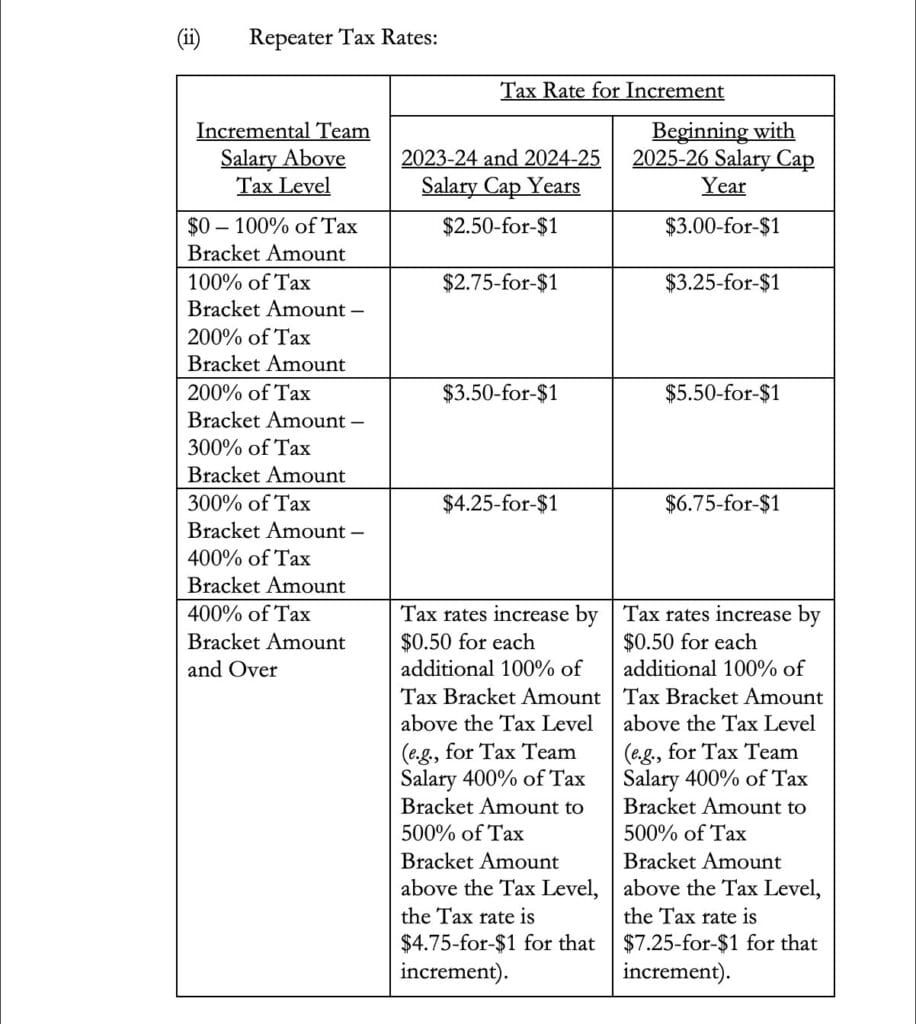
The cynical approach would be suggesting that waiving-and-stretching Beal is Ishbia’s response to an expensive season that ended in disappointment. But the Suns owner has repeatedly asserted that money is no object if he believes this team has a chance to contend, so perhaps the more realistic interpretation is Phoenix understands this year’s team won’t be contending for a championship and is adjusting accordingly.
To that point, why wouldn’t the Suns try to duck the second apron for a team that is clearly not second apron-worthy, especially if it gives them their best chance to retool and put this franchise back on course over the next few years? Booker will be approaching his 31st birthday by 2027, so keeping Beal’s full salary on the books for the next two years and waiting until then to make any meaningful moves might have been a death sentence for the Suns’ ability to contend with what’s left of Book’s prime.
Waiving-and-stretching Beal comes with a few long-term obstacles, and it’ll be on the Suns to remain beneath that second tax apron despite Beal’s dead money providing an unfortunate head start. How they maximize that wiggle room will be everything.
But ducking the second apron now frees up trade flexibility, opens up the MLE and puts the Suns in a better position to eventually unfreeze their 2032 first-round pick, prevent that pick from being moved to the back of the first round, get out of repeater tax territory, and avoid their 2033 pick being frozen as well. Time will tell if the Suns are proven right in this belief, but the hope is that paying Beal $19.4 million a year over five years to not play for their team will be more of an emotional blow than the financially crippling one it’s being made out to be.