

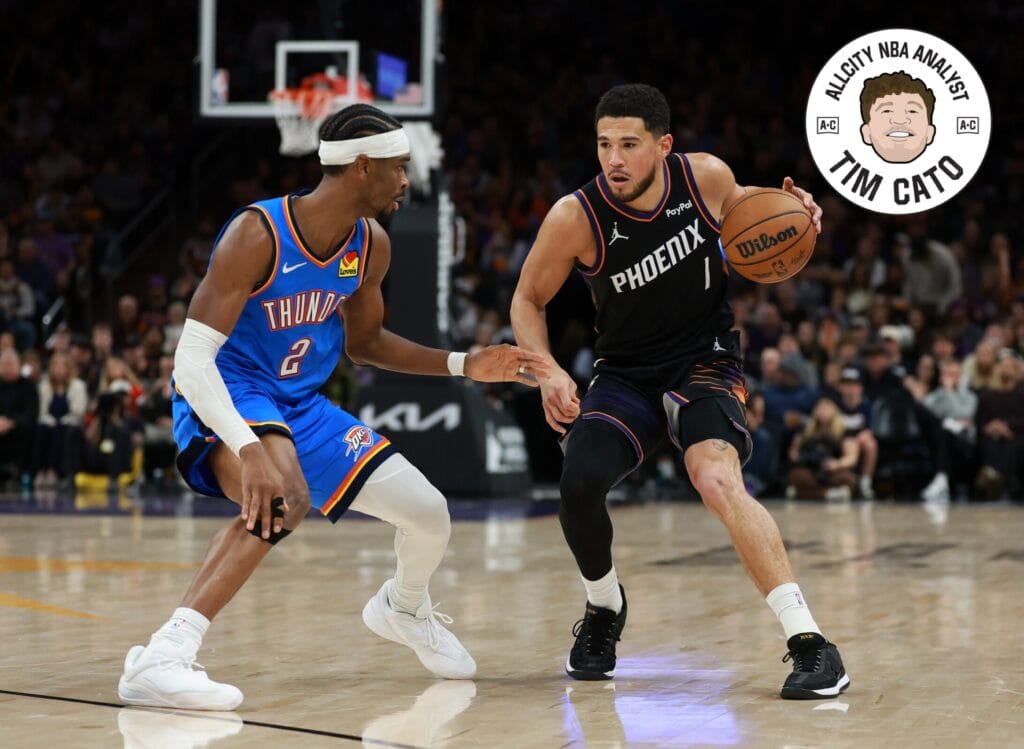
The Phoenix Suns have been the Western Conference’s most surprising story. It was plausible that the San Antonio Spurs would take a leap, or that the L.A. Clippers would nosedive due to age, even if both outcomes weren’t predicted, but no one expected this from Phoenix, a squad that seemed destined for a transitionary season or, perhaps more accurately, a transitionary half-decade.
Instead, Phoenix is 21-15 this season, sitting seventh in the Western Conference and just two games back of a top-six seed. If you need further proof of this surprise, ask the oddsmakers: No team in the NBA has outperformed its spread by more points than Phoenix this season, and it’s not particularly close. Here are a few reasons why the Suns have had this success thus far.
1. The Suns know how to survive without the league’s best shot
Phoenix turns just one out of every four shots into a layup or a dunk. They have the league’s 29th-worst rim attempt rate (25.7 percent), a statistic better but reminiscent of last season, where the Suns finished dead last (21.7 percent), a calamitous season that led, of course, to the departures of Kevin Durant and Bradley Beal. That alone should have made Phoenix’s offense worse before factoring in Jalen Green’s extended absence, which has limited him to just two games.
But it hasn’t. Phoenix’s offense this year, good for 114.6 points per 100 possessions, is just a fraction away from last season’s (114.7).
It’s not Phoenix’s choice to avoid layups, of course, but the team’s reality. They don’t have blindingly athletic speedsters who teleport there — this is what’s most intriguing about Green’s looming return — nor do they have one of the league’s few transcendent creators who pass those shots open. Devin Booker ranks 12th-overall in gravity, per the NBA’s metrics, and he’s improved as a passer over the past few seasons. But while his methodical drives do attract opponents’ attention, he mostly uses that to spray the ball out to the perimeter whenever he’s not settling into comfortable pull-up 2s. There’s nothing wrong with that; that’s his game.
What Phoenix does to make up for that is, ironically, all about the rim. They actually love being there, just not to shoot. The Suns’ offense this season has succeeded because of offensive rebounding, and because those second chances repeatedly get turned into 3-point looks.
This season, Phoenix has the league’s fifth-best offensive rebound rate and takes the 11th-most 3s, by share of their total shots. (They’re the 11th-best 3-point shooting team, too.) The Suns don’t have the personnel to live at the rim, but they do have a plethora of willing shooters. Collin Gillespie has turned into one of the league’s best movement shooters; Royce O’Neale is a catch-and-relocate-and-shoot expert with deep range; Grayson Allen, despite missing 17 games, has similar shooting prowess; Dillon Brooks is capable both spotting up and creating pull-up 3s.
Jordan Goodwin is the embodiment of this process. The fifth-year guard picked up after being waived by the Lakers last summer does shoot 3s, and lately he’s been on a heater. But, despite standing 6’3, he also has the league’s 20th-best offensive rebound rate. He’s the only guard-sized guard — meaning under 6’5 — amongst the NBA’s top-40 players in that category. His knack for worming around and through taller big men to secure second chance balls is exactly what head coach Jordan Ott has had in mind for this team.
Make no mistake: This is clearly Ott’s influence. Phoenix sends three players to crash the glass about 24 times per game, which leads the league. Only one other team, the Cleveland Cavaliers, where Ott coached last year as Kenny Atkinson’s lead assistant, does it about as often as the Suns (23.2 times per game). The next closest team, the Memphis Grizzlies, send three crashers just 17 times per game.
Ott understand this isn’t the league’s most offensively talented team, nor one that will constantly generate high-percentage shots. It’s a simple fact that this team, with this steady of a 3-point diet, is going to miss shots. Instead of surrendering to that fact, Ott’s built an identity, thus far, that leans into it.
2. Phoenix has two tough shotmakers, too
One more reason this works for the Suns, of course, is that they have a couple players who will take and make tough shots, specifically mid-range pull-ups. Booker’s entire career has been based around his inside-the-arc proficiency, but it’s Brooks who has emerged as a complement to him. Those two are the league’s fifth- and 13th-most prolific mid-range shooters this season.
Again, at least to some extent, that volume is a reflection of an offense that hasn’t had the personnel to be a top-10 unit. (Green’s best-case scenario could change that.) Because Phoenix thrives at rebounding missed shots, it’s synergistic with the team’s identity to let Booker and Brooks take difficult jumpers. That said, those two have been nice with it, as the kids say. This season, the quality of Booker’s non-rim 2-point attempts are the toughest they’ve been in the past seven seasons, per Second Spectrum. (Getting Booker easier looks is another hoped-for result of Green’s return.) Because he’s Devin Booker, he’s still converting 49 percent of those shots, which is about nine percent better than the average player would.
Brooks’ numbers look about the same and, unlike Booker, that’s a severe aberration compared to his career. It could just be that he’s found the perfect sweet spot to his game; he’s always had the ability to make tough shots even if previous coaches didn’t love his proclivity towards them. (And for good reason, since he never made them at this rate until this season.) Unless or until he stops making them, there’s really no need for him to change his approach.
3. The Suns’ defensive identity mirrors its offense
Phoenix’s defense has its own method to maximize possessions: turnovers. The Suns, who currently rank eighth overall in defense, have the league’s second-best turnover rate behind only the Oklahoma City Thunder. On about 17 percent of possessions, they entirely prevent opponents from even attempting shots. That’s the statistic most correlated to success this season, something we explored last month; it’s another way that Phoenix’s identity is synergistic on both sides of the ball.
The Suns achieve don’t achieve through with any single avenue. It’s a combination of ball-hungry harriers (Gillespie, Allen) and smart positional defense that shrinks the floor. In Phoenix’s stellar win against the Oklahoma City Thunder this past weekend, the Suns placed its centers, either Mark Williams or Oso Ighodaro, on Lu Dort and occasionally Alex Caruso. (There’s a lot more to say about that game and the Thunder’s slide; stay tuned this week.) Most NBA fans are familiar with that concept, which allows teams to keep their shot blocking centers nearer the rim instead of guarding more involved or better shooting centers. But Phoenix often runs possessions like this one below, which almost looks like a zone, but isn’t.
This is a fluid man-to-man look; the team’s size and rim protectors stay towards the rim, and Booker allows any cutters to be picked up by his teammates beneath him, because he’s not one of those sizable shot blockers. (It’s also an offensive rebound deterrent.) There’s almost always someone dug deep into the paint; towards the end of the clip, Ryan Dunn is camped out there until Dort, the defense’s designated non-shooter, crashes down into him. And then Shai Gilgeous-Alexander ends up turning it over.
But you can also force turnovers just by swallowing up opponents, something Brooks particularly does well. Here’s another example from that game.
Last week, before Phoenix lost to the Cleveland Cavaliers, Ott’s former boss, Kenny Atkinson, praised what Ott has been doing with his new squad.
“Listen, he’s doing a hell of a job,” Atkinson told reporters prior to the game. “I mean, to me, the Suns are the hardest-playing team in the league right now. They play harder than anybody. That’s what I see. I’m not at the game, but it jumps off the page. So that’s a real credit to him.”
There are many more layers of nuance and tactics to the team’s defensive success this season, of course, but Atkinson did get to the heart of what this Suns team has been doing, on both ends, with its surprising success this season. They’re playing smart, they’re playing hard, and they’re better positioned in the Western Conference than anyone could have anticipated before this year began.