

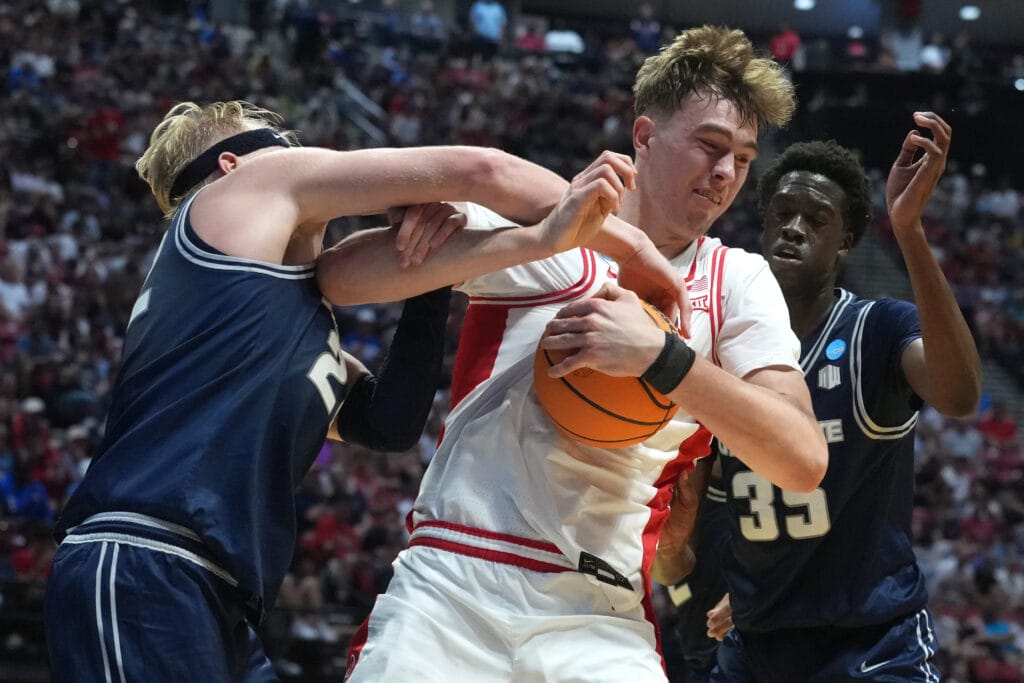
The Arizona Wildcats didn’t just debunk the West Coast soft label, they dismantled it, one body in the paint at a time.
The question landed in the Final Four press conference like a lot of lazy assumptions do, dressed up as a compliment, wrapped around a stereotype that never quite fit.
“After years of being labeled a finesse program, what specific adjustments…“
Tommy Lloyd didn’t let it finish.
“Who labeled us that?”
The reporter stumbled. He’d heard it somewhere. Didn’t really believe it himself allegedly.
“Listen,” Lloyd said, leaning into the microphone, “if we’ve been a finesse program the last few years, I think people are being a little bit lazy. Finesse basketball has never been in my DNA. If you go back a lot of those years, those teams we had at Gonzaga were incredibly physical. To me, that physicality is the price of admission. If you’re not physical and you’re not willing to go toe to toe and fight, eventually, I don’t care what type of tricks you’ve got up your sleeve as a coach, you’re probably going to come up short. For me it’s a baseline requirement to be a championship [program].”
The press conference ended there due to time, but it was notable and the answer deserved more education for those that unknowingly fall into the trap of West Coast basketball being “soft.”
Tommy Lloyd just described, in a single breath, the entire arc of Arizona basketball over the last five years – far from anything resembling run ‘n gun offenses with no substance.
When Lloyd arrived in Tucson in April 2021, he brought a system built on pace, ball movement and offensive explosiveness forged over 22 seasons as an assistant at Gonzaga. From his very first season, Arizona led the country in assists per game and ranked third nationally in scoring, averaging 83.9 points per game. The Wildcats were electric. The basketball was beautiful. McKale Center was loud again.
But beautiful doesn’t always survive March.
Tommy Lloyd’s first two Arizona teams got bounced from the tournament because, simply put, they weren’t tough enough. The 2022 team, a No. 1 seed, ran into a Houston squad that wanted to fight and found out the Wildcats weren’t quite ready for that kind of war. The score didn’t accurately reflect the physical beatdown Arizona experienced that night, but Houston’s identity did. The Cougars were meaner. And in the NCAA Tournament, mean matters.
The West Coast soft label had a data point. Lloyd quietly noted it.
What followed wasn’t a stylistic abandonment, it was a physical evolution. Lloyd didn’t scrap what worked. He added weight to it.
The recruitment shifted to stronger, more physical guards, forwards who could operate in traffic and bang with the big boys when needed, players who’d been tested in hostile environments. His 148 wins in the first five seasons are the most for any head coach in NCAA Division I history, but the wins in years three and four started to look different than the wins in years one and two, especially once they made the jump to the Big 12. The Wildcats began winning games that felt like they were decided not just in transition, but in the grind of the final four minutes.
His next two teams didn’t suffer from the same toughness issues that plagued the early tournament exits. The program had found its edge. The Princetons of the world would never be able to compete with these Wildcats.
Then came this season. And Lloyd went all-in.
Brayden Burries, Ivan Kharchenkov and Koa Peat combined to make 99 starts for Arizona this season, producing nearly 50 percent of the team’s scoring alongside veterans who understood the blueprint. On paper, a team built around three freshmen sounds like the kind of squad that gets bullied in big moments. On the court, it looked like the opposite.
Burries, Peat and Kharchenkov don’t have the size or bodies of “tweeners.” They didn’t need a year to fill out their bodies. They are grown-ass men who impose their will physically on the opponent and often times do so with ease.
Brayden Burries credited the Big 12 directly, “I think it honestly helps us a lot. The Big 12 is one of the best conferences out there. It prepares us physically, mentally, through adversity because you’re playing a great team night in and night out.”
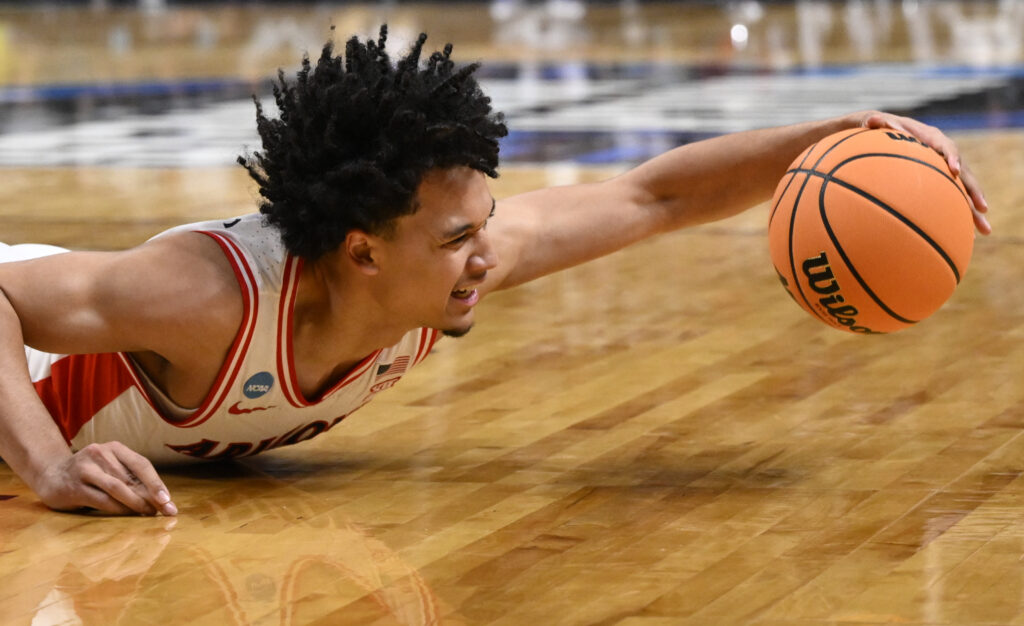
Koa Peat echoed it without hesitation, “The Big 12 is the best conference in college basketball. It definitely got us prepared for this moment.”
This is where the “West Coast soft” myth begins to crumble entirely. Arizona spent a full season in the roughest grind in college basketball, competing in a league that produced multiple Final Four-caliber teams, finishing with a 29-2 regular season record and winning the conference tournament. The Wildcats didn’t just survive. They started the season 23-0, the best start in both school and Big 12 history.
They won on the road against UConn, a physically imposing team themselves. They defeated the vaunted frontcourt of the defending national champion Florida Gators while Peat drop 30 on their heads. They’ve bludgeoned teams to death in the paint by averaging a whopping 42 points per game. They make more free throws than most teams attempt against them. Why? Because they’re about that life!
Then March arrived, and Arizona put two different identities on display in the same tournament run, and both were physical.
Against Arkansas in the Sweet 16, the Wildcats came out and attacked the paint relentlessly. Lloyd explained the game plan simply after the win, “I thought we could have a lot of success offensively, whether it’s running our flow or transition or just pounding the paint.”
Single-digit three-point attempts. Foul pressure. Bonus time weaponized. Arizona scored at will, not because it was the more talented team in a shootout, but because it was stronger and more deliberate. The final margin was never in doubt after the first ten minutes.
Darius Acuff Jr. was a trend, Arizona as a whole was the bar.
Then came Purdue. A completely different challenge. Size. Strength. The kind of physical imposing frontcourt that had pushed Arizona around in different forms in previous tournament lives.
Not this time.
Purdue had no answer for the relentless attack Arizona had in store for them physically. Trey Kaufman-Renn was in foul trouble as soon as he exited the locker room.
Arizona rallied from a halftime deficit to beat Purdue and reach its first Final Four since 2001.
Soft teams don’t wilt to size, they impose theirs.
One of the quieter numbers that defines this season of Arizona basketball: the Wildcats get to the free throw line. A lot. Critics have grumbled about it. Opposing fans have whined like crazy about it. Lloyd has never apologized for it.
After the first-round win over Long Island, Lloyd addressed the foul question directly, “I don’t know if we struggled with foul trouble. I think the people we play against struggle with foul problems. That’s how I look at it. When you’re a physical team there’s going to be whistles.”
That’s not arrogance. That’s a program philosophy. Arizona attacks the basket, draws contact, and puts opponents in foul trouble early. It’s a strategy as old as the game, but it requires a specific kind of player, aggressive, fearless, willing to absorb contact and still finish. Arizona’s fewest three-point attempts in the tournament this season tells you everything. They didn’t need the three. They went through you.
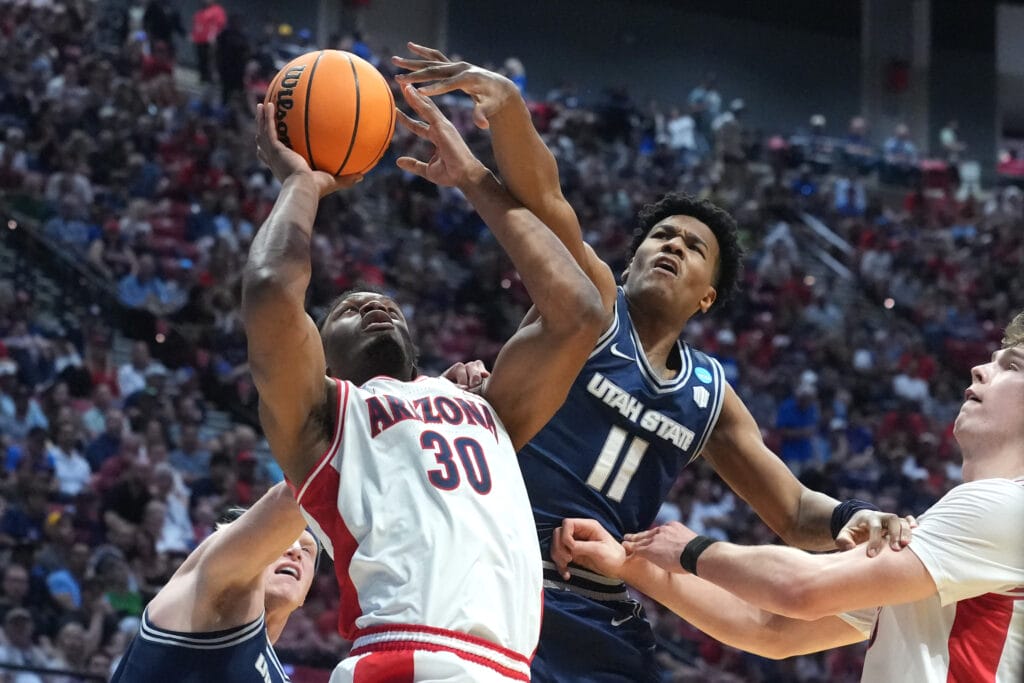
The chatter on social about the lack of even foul calls can be directed at one simple thing: coaching. Arizona is disciplined and staunch at verticality. If your player flops, that’s on him. Don’t sweat the technique.
The thing Tommy Lloyd understood that the label makers never did is that the Gonzaga teams he was a part of weren’t soft, either.
Those WCC Bulldogs were consistently among the most physical programs in the country. They set screens that cleared out defenders. They posted up. They boarded. They were often the biggest, strongest team in their conference by such a margin that the “West Coast” tag seemed unfair to begin with. Lloyd absorbed all of it over 22 years under Mark Few.
When asked about his sideline demeanor, Lloyd pointed directly back to his mentor: “Look at my mentor. He’s pretty cool, calm and collected, Mark Few. Obviously when you’re with a guy for 22 years, you learn a lot by osmosis.”
He learned how to win, too. And specifically, he learned that no matter how pretty your offense is, you cannot win championships playing scared, playing light, or playing soft.
Now, five years later, Arizona is in Indianapolis at the Final Four for the first time in a quarter century, preparing to face Michigan, this time with everything on the line.
They got here because they can run. They got here because they can score. They got here because they move the ball, they defend, and they trust their system.
But mostly? They got here because they stopped being interested in being labeled anything at all and started being interested in being the toughest team on the floor.
That’s the price of admission.
Tommy Lloyd has been collecting it for years. As they say, education is elevation!