
There have been highs. There have been lows. But overall, it was a disappointing 2026 season for Phoenix Rising.
While celebrating the team’s 10th season since the rebrand, Rising failed for a fifth consecutive year to finish high enough in the table to host a postseason match. The club’s stay in the playoffs lasted just one week, ending with a humbling defeat to rival New Mexico United.
Amid poor attendance and declining performances on the field, Phoenix Rising is at a crossroads. The team needs to face difficult questions about how it got to this point, what needs to change and who exactly can take the club forward.
But as we conduct this postmortem for 2026, four figures stand out as deserving the most scrutiny. Each has a different role and bears a different share of responsibility for why the team is where it is.
The coach: Pa-modou Kah
When Pa-Modou Kah joined Phoenix Rising ahead of 2025, he was billed as the face to “elevate” the team both on and off the field. Two seasons later, Phoenix Rising has ended up exactly where it was in 2024: an eighth-placed finish, and a first round exit away in Albuquerque.
2025 was a step forward. The team had it in their hands to host a playoff game as late as the final match and proved difficult to beat in the postseason. This year, Rising handed away control of its playoff qualification fate as the final regular season whistle blew and, as they entered the postseason, looked completely unprepared to face New Mexico in the opening match. It wasn’t progression. It was regression.
We can’t ignore that injuries played a role in this season, but they’re not a new issue. Rising dealt with this last year, too. In fact, it has seemed to be the only constant since Kah arrived in Arizona. Availability was harmed further by poor discipline, and that is something that has to sit at the door of the head coach.
Beyond that, we can look at the impact Kah had within individual matches. Last year, it was undeniable that his in-game tweaks had an impact on results. He clearly knew how to influence games. Yet this year, just one match in all competitions – a USL Cup game against Orange County – saw Rising win after conceding the first goal. Injuries may have played a role in decimating his bench, but it’s still an indicator that his influence may not have been the same.
Still, his team did show resilience in the last few regular season games despite having backs to the wall.
Arguably the biggest argument against Kah’s tenure is the stalled development of young players at the club. Pape Mar Boye was an all-league player in 2024, and Hope Avayevu was in 2025. By 2026, both are, to be frank, candidates to be moved on. Their progress seems to have completely stalled, and it shows on the pitch.
On the other hand, Ihsan Sacko just had the best season of his career. More importantly, we saw the transition of Gunnar Studenhofft from a player that attracted much criticism at the start of the year into a serviceable role player by season’s end.
Is it Pa-Modou Kah’s fault this team failed in 2026? There are people who’ll point to the supposed talent within the squad, and there’s no doubting that talent exists there. But to scapegoat him ignores the past of this club. Nobody in the last few years – not Pa-Modou Kah, Danny Stone, Diego Gomez, or even Juan Guerra – has managed to produce the consistency required for a home playoff match with this club, despite the undeniable talent here.
The model might tell you they’re talented, but whatever they do, they never reliably show it. At some point, after four seasons, you have to accept: either this club is completely inept at hiring a head coach or the way that the squad’s quality is being evaluated is flawed. At some point, the observed results have to mean more than the theory.
So do you stick with Pa-Modou Kah as Phoenix Rising’s head coach? At the end of the day, you have to ask what the project is here and how he fits into that. It isn’t a question of Kah’s talent, which I don’t doubt, but a question of fit.
Either way, you have to decide if you’re all-in or all-out on Kah as head coach. This can’t be a half-measure. Either he is your guy and should be backed appropriately into 2027, or he isn’t and you have to move on. Otherwise, you risk wasting another season by acting aimlessly.
The sporting director: Brandon McCarthy
“It’s the group we want right now.”
Those were the words from sporting director Brandon McCarthy as 2026 kicked off. Clearly, as the dust settles, that group wasn’t enough.
Over McCarthy’s four full seasons as sporting director, Phoenix Rising has hosted a total of zero playoff matches. For a club that considers itself – or at least, used to consider itself – one of the leading teams in the league, that isn’t an acceptable outcome.
Worse yet is that things aren’t moving in the right direction. McCarthy’s biggest success came in his first year, with a championship earned primarily off the back of a hot streak of four matches, three of which would have ended as draws outside of knockout football. Yes, it was an achievement, but you can’t judge on four games alone. And it shouldn’t provide cover years down the line, either.
When push comes to shove, the whole body of work is unimpressive. Rising has lost more regular season games than it has won over the past four years, a sample size of 128 games. Compare that to Itamar Keinan at New Mexico United, who in three full seasons as sporting director has recorded two first-place finishes plus a Western Conference final in the other year, and it just doesn’t look impressive.
So what has McCarthy done well? It’s undeniable that he has found a knack for identifying players other USL clubs wouldn’t find. Jearl Margaritha was an inspired signing. Ihsan Sacko too came in under McCarthy’s oversight.
But that hasn’t translated into results. Brandon McCarthy is not just a scout. His job isn’t to find a couple of impressive players and hope it all works out. His job is to build a genuine squad that is ready to compete, and establish a broader sporting identity.
That’s where the problem lies. Whatever the project is, it clearly isn’t working. Four years of work in USL is an eternity, as we’ve seen in how quickly other clubs can rebuild into competitors.
So what do you do? Do you change the coach and hope that this time it’ll work out just right? You could, but it’s not as though McCarthy has a track record of hiring coaches that produce that consistency needed. Why trust him with another appointment and expect results to be different this time around?
Look more deeply at the project that McCarthy is building. We all know of its focus on picking up unknowns from overseas, and being the best at that. But different for different’s sake is just tinkering without any point. If Rising isn’t outgrowing its station – which it isn’t, based on the on-field results – then what is the actual point?
There have been small wins along the way, including Darius Johnson’s transfer to San Jose. But if the aim is to win games, that’s not relevant unless the money is reinvested into winning games. And if the aim is money? Perhaps a greater willingness to invest in proven USL talent sometimes, instead of dogmatically avoiding it, would finally push Rising over the line for a home playoff match and the revenue that brings.
McCarthy’s baseball background has gotten him a short leash from the fan base, and I understand why. It’s also worth noting that his volunteer status and ownership stake have raised genuine questions about what real internal scrutiny he faces. I don’t think it’s unreasonable to ask those questions, and any other sporting director with his record would, or at least ought, to be facing the heat.
So does he stay? Four years is more than enough time to establish the direction for a football club. If, after all that time, we’re still seeing next to no improvement, then surely it’s time to take a change of approach seriously.
The club president: Bobby Dulle
For as long as there’s been Phoenix Rising, Bobby Dulle has been leading it. There’s no question about the role he played in the team’s initial rebrand from Arizona United.
But that was ten years ago now. So is it time for a change?
It’s clear the momentum this club once had, where it was the hot ticket in town, is gone. Rising’s average attendance increased slightly this year, buoyed by late-season promotions and Dollar Beer Nights, but the reality of the past two years paints a grim picture. Official attendance hovering around the 5,000 mark, which represents just half of the stadium’s capacity, does little to help instill confidence. Even with the improvement, the team is still averaging over a thousand fans per game fewer in 2026 than in 2024.
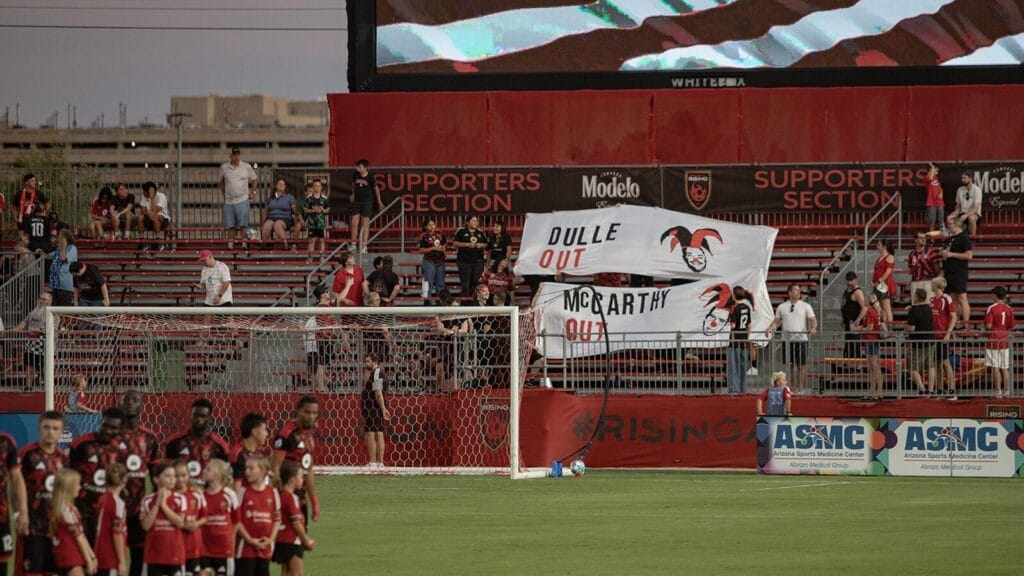
It’s clear by now that confidence from Phoenix Rising’s supporters’ group has run out, as demonstrated by protests earlier this year. Even beyond that, a scroll through social media tells you a lot of how Dulle, as well as McCarthy, are perceived. You don’t tend to see many offer up much of a defense for them.
This isn’t the first time we’ve seen animosity toward Dulle. Back in 2024, over the firing of Danny Stone, you could hear the noise. It subsided for a while, but now it’s back. Eventually, there’s the equivalent of losing the locker room. When the club’s most vocal supporters turn against its leadership, and that message cuts through beyond their circle, it becomes harder to see a path back.
The task of building that buzz around the club, of packing out a stadium, of converting people into fans, is arguably one of the most important that a football club faces. Everything flows from that to an extent. A decline in that regard can make the club less attractive to sponsors, limits investment in the playing squad and ultimately makes competing for trophies more difficult.
That’s why it’s been so frustrating to hear repeatedly about Dulle’s involvement in identifying players to recruit. And we have heard that, time and time again, in comments made in press conferences over the past couple of years.
After all, if a Dulle signing scores and there’s nobody there to see it, did it even really happen?
There seems little point in establishing a sporting department at the club led by a director if the end product is still the President weighing in excessively on those kinds of decisions. That is doubly the case when the seas are far from calm in other areas of the club.
The question we’re asking now shouldn’t be what Bobby Dulle did five years ago. It shouldn’t be what he did ten years ago. It should be about what he can do now, and why he’s the best candidate for the job of getting the club back to where it belongs in all facets. But if you’re looking to see how he’s made that case in the past couple of years, you’ll likely draw a blank.
If the job was up for grabs now and Dulle applied, would you give it to him? Because for many reading this, and frankly for myself, I’m not sure the answer would be yes.
Phoenix Rising’s owner: Pablo Prichard
Writing about Dr. Pablo Prichard, Phoenix Rising’s plastic surgeon-turned-principal owner, is probably the hardest of these four figures I’ve had to tackle.
In a lot of ways, that illustrates the point here. We don’t really know enough about what he’s doing at the club.
In large part, that’s because Prichard just isn’t a visible owner. And that’s not necessarily a bad thing. But it does raise questions because he certainly was more visible in the past.
Some of you will remember seeing him speak at the championship celebration. Some of you will remember him stepping out of a helicopter onto the field at Rising’s stadium before kick-off. And some of you will remember him from trips to the South End on matchdays.
None of those have happened recently, but Prichard retains his hold on the club. It’s one that’s grown since the 2022-23 offseason, when his Vincere Capital started putting money into the club alongside gaining representation on the board.
Now, he’s also getting the ire of the supporter protests, with a “Where’s Pablo?” banner raised this season.
That disconnect is a large part of the issue. The fans see what’s around them. There are the temporary stands that look like they’re being held together by zip ties, the poor matchday experience, and the failures on the field. When they’re met with silence, they fill in the gaps themselves.
They’re not wrong to do so. This is a club that had ambition. They want to see that ambition once again. This is a club that used to have owners that people recognized, that they could engage with. Now, they look for Pablo Prichard and find nothing. The only real communication of the past months came from Tim Riester, whose statement to The Arizona Republic went down like a lead balloon, offering little substance beyond references to nondisclosure agreements and appeals for supporters’ trust.
So what do they need to see? They need to see the standards set for the club below the principal owner, with some form of accountability for the perceived failures at all levels. They need to see movement toward investing in the matchday experience, or concrete steps toward a permanent stadium deal. They need to see investment in the playing squad that actually produces success in the way Rising’s fans became accustomed to in the early years.
And while recognizing that all of that can take time to put together, they above all need to hear from him. They need to know he actually still cares about this club and wants to take it to the heights his early enthusiasm suggested he did.
This isn’t to blame Prichard for the flaws of the last few years, at least not yet. He isn’t responsible for every decision made by those he employs. But the ball is in his court. He needs to demonstrate that his ownership offers something more than just keeping the club afloat financially, and that he has a clear direction for Phoenix Rising’s future.
Because if the fans don’t see that? I fear they’re just going to keep drifting and drifting away.