


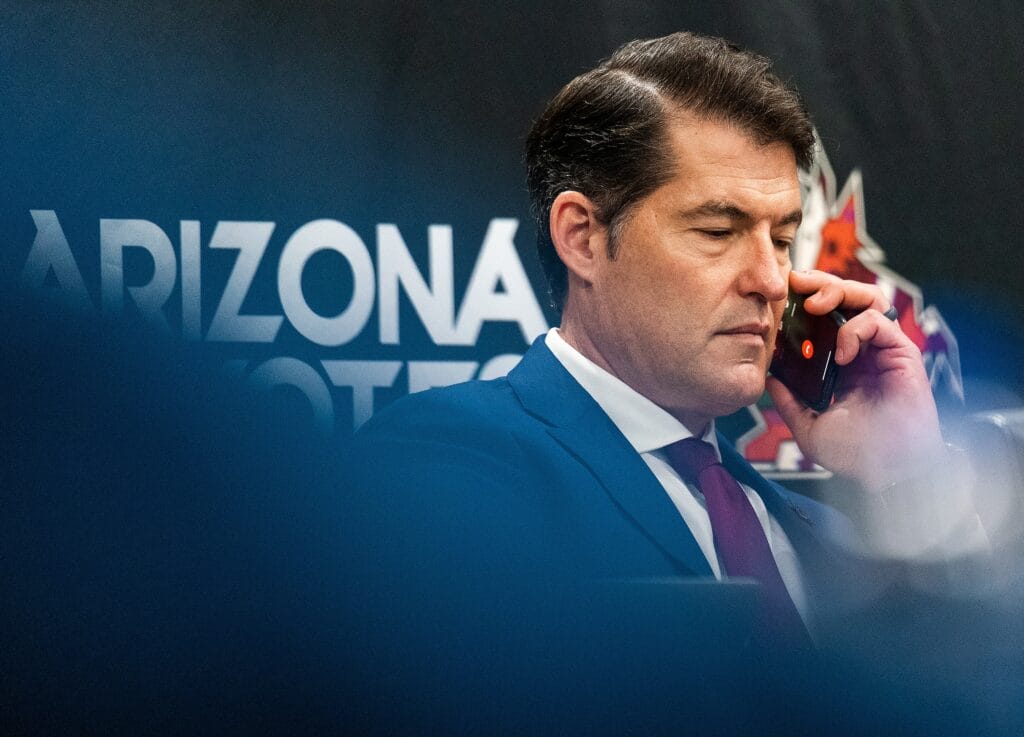
ST. LOUIS — When the Blues beat the Coyotes with a seven-goal outburst at Gila River Arena on Oct. 18, Boston University forward Jamie Armstrong dialed up his dad.
“He said, ‘The bad news is, you got your ass kicked,’” Bill Armstrong said. “‘The good news is, everybody that scored for St. Louis, you drafted.’”
When Armstrong returned to St. Louis in February for the first time since the Coyotes hired him as their GM, there was little to evaluate from his performance. That’s because Armstrong was in evaluation mode himself. He was evaluating his players. He was evaluating his coaches. He was evaluating Arizona’s prospect and asset pipelines, and he was evaluating his staff.
Nine and a half months later, and 14½ months into his Arizona tenure, Armstrong arrived in his Midwestern training ground with a dizzying array of roster and staff moves in his wake. He traded team captain Oliver Ekman-Larsson and team spark plug Conor Garland. He traded goaltender Darcy Kuemper and center Christian Dvorak. He revamped the scouting and hockey operations departments, he let key free agents Alex Goligoski and Michael Bunting walk away in free agency, and he acquired so many 2022 draft assets that if he executes all eight of the team’s first- and second-round picks, the Coyotes will set an NHL record for picks in the first two rounds of one draft.
Maybe that’s why Armstrong hadn’t given much thought to the Blues’ offense-fueled, 8-4-2 start. There hasn’t been any time to think about it.
“You’re so focused and locked into what you’re doing with your own team, but then you look across and you realize, ‘That’s it!’ That’s the goal, what you’re seeing with that team you were just with,” he said. “I was there when there was nobody in the building, when we had no ownership and it was the worst of the worst. The team was bad and we picked number one overall (2006).
“The thing that I love about that is the simple fact that through all those years of working, you know you had a direct impact in helping the Blues win a Cup with what I brought to the table.”
Armstrong is at the ground floor of that process once again. The Coyotes were a league-worst 1-13-1 heading into Tuesday’s game against the Blues at Enterprise Center. They are the butt of jokes, there is concern for the mental state of some players, and there is some talk in fan and league circles that Armstrong may have taken this tear-down approach too far.
Armstrong played and coached in the AHL. He is very much a competitor and he wants to win, but he said he can’t let that emotion cloud the bigger picture.
“I don’t think there’s a halfway in a strip down,” he said. “You either go in or out; you can’t sit in the middle. I think we probably went as deep as we could without setting new league records, but as a competitor, it is tough. Your self worth in this industry is valued by how you show up and it’s valued around wins. The guy that’s got the best team in the NHL is walking around, feeling good.
“For us, there are days when it’s really hard so our confidence and our motivation has to be focused more around the process. It has to be focused more around the commitment to get better. When you do that, it certainly can take a little bit of the sting away when things aren’t going well.”
Armstrong believes that the draconian measures he put in place were necessary.
“This was not your normal situation where you’re walking into a good team and you’re just going to be a general manager,” he said. “We had picks taken away from us so we had a limited amount of picks and then you come in and the pandemic hits so it truly was a lot of balls in the air. We had to figure out a way to get as many assets as we could.
“It’s almost like turning a ship around. It takes a while to turn the ship and to get it going in the right direction. That’s what we had to do with all the moves and the transactions that we made in the summer to put the plan into action so we could execute. We stuck to our guns, but number two, we were very fortunate, let’s be honest that we were the last one holding a goaltender and the last one holding a center. I will give our ownership credit in the fact that they’ve allowed me to operate with no pressure on their end about making decisions. It wasn’t like something was mandated that you’ve got to move this guy here. They gave us all the freedom in the world to make the decision at the right time.”
Armstrong knows that he has his share of critics. He knows that ultimately, he will be judged on what comes next; not the draft picks that he has acquired. But there is a sense of calm as he surveys a team whose season he admits may be painful to watch. It’s an approach that he learned from three of his greatest mentors in St. Louis: Blue Jackets GM Jarmo Kekäläinen, Larry Pleau (now his senior advisor with the Coyotes) and Blues GM Doug Armstrong.
“You have to have the conviction to make unpopular decisions, you have to have the conviction to stick with it, and you have to have the conviction to live with the results,” Doug Armstrong said. “They have an abundance of draft picks, but the reality is, it’s a long road. If you just take NHL averages, these guys should pop their head up in three to five years. The first overall pick is a different animal, but late first-(round picks) and early seconds are usually three to four years out; three years potentially before they get a game and then four years before they’re starting to have an influence on your team.
“That’s where I really think Billy’s experience is gonna pay dividends. He understands that failing players is not an option for him. He’s not gonna waver on the long-term success and he understands that the growth patterns of that long-term success very rarely change.”
That growth pattern is something that Bill Armstrong learned in six years as an area scout (the first two part-time), eight years as the Blues director of amateur scouting, and two more as St. Louis’ assistant GM and director of amateur scouting. But he also learned the importance of exhaustive research and sticking to his guns.
“It’s easy to say, ‘That player is pretty good,’ or ‘That guy is not bad.’ But to say, ‘Yes, I want this guy’ or ‘No, I don’t want that guy,’ those are important qualities of a good scout for me,” Kekäläinen said. “You don’t sit on the fence. You put in the work, you make a decision and you go after your guy. Or, if a player has a high profile and everybody seems to like him, you have the courage to say, ‘No, we don’t want that guy. He doesn’t play the way we want the players to play in our organization.’
“That’s what scouts get paid for and Bill can make those decisions. He was decisive. He did not sit on the fence. It takes a while to find out if a guy is a good scout or not but he certainly proved that he was a good talent evaluator.”
Despite Armstrong’s ability to land first-round picks in separate trades this offseason with the Canucks (Ekman-Larsson, Garland), Avalanche (Kuemper) and Canadiens (Dvorak), some analysts have suggested that he has executed only the easy part of the process.
Doug Armstrong agrees that acquiring assets is the easiest part of a process that will soon include drafting, developing and perhaps trading assets, along with signing free agents. The misconception, he and Pleau said, is that because Step 1 is the easiest part of the process, people think that it is actually easy to execute.
“Ask the people going through it,” said Pleau, who was the Blues general manager from 1997-2010. “Ask the owners if it’s easy. It’s not. It’s really tough. It’s tough to watch it. It’s tough to get what you want in deals. It’s tough to take action like that. You’re affecting families and everybody is questioning it. I don’t know if you ever get comfortable with it, but it’s a step that you’ve got to go through.
“You can’t let outside pressure affect your decisions. You have to do it based on your data, what your ownership feels, what you feel and what your staff feels. You’ve got to move on from certain people, from certain players, certain scouts. It’s not something you want to do but if you think that this is better for the organization you do it. Whether it’s easy or hard, it’s part of the job.”
When they took the ice in St. Louis, the Coyotes had 67 games remaining in what is sure to be an agonizing 2021-22 season. It’s not likely that the 2022-23 season will look much better, but Armstrong insists that mounting losses will not force him off of the course he has set for the franchise.
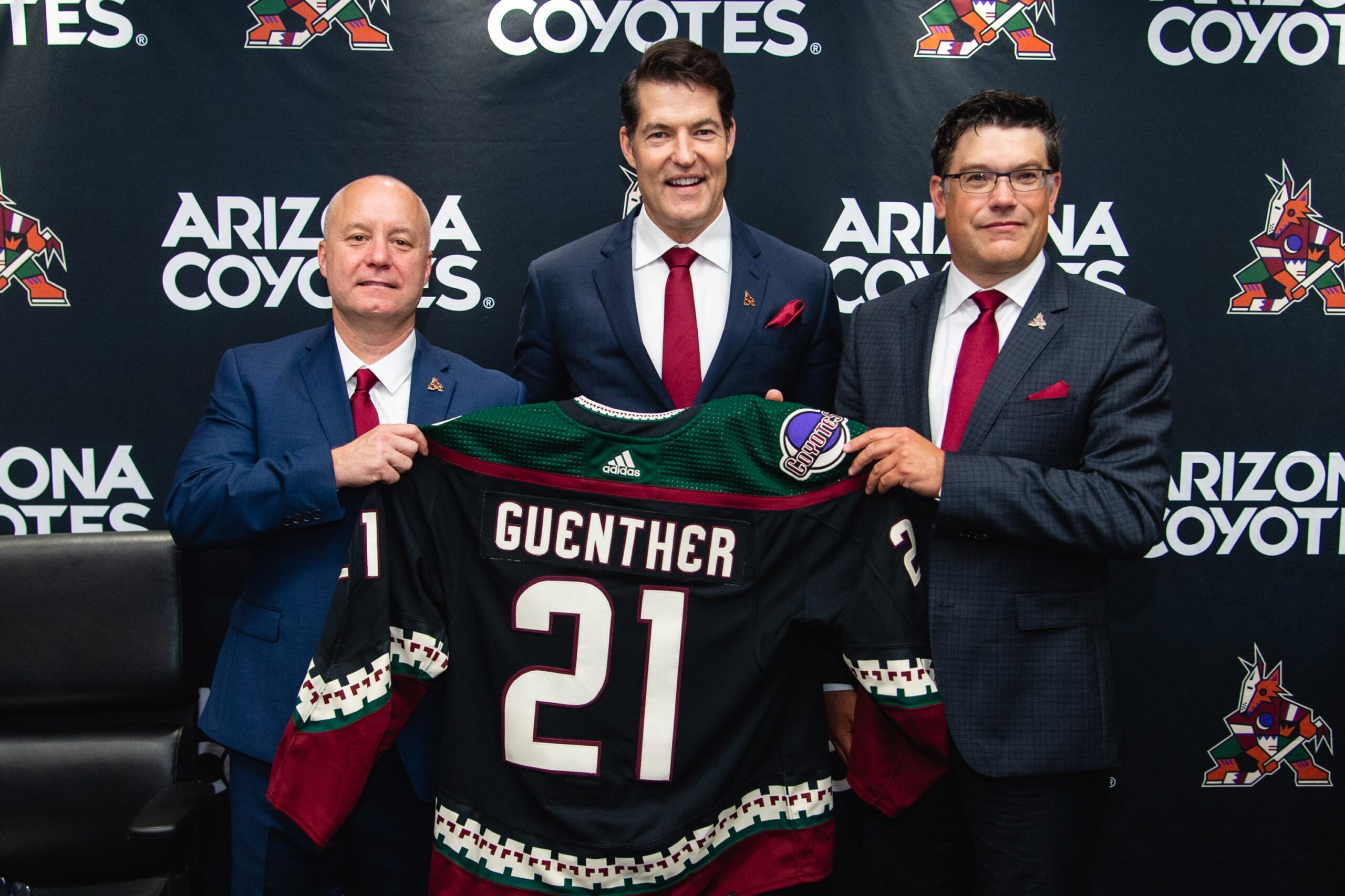
“I really like where we’re at,” he said. “I thought when we got Guenther, that was a difference maker for us because it moved us a little farther ahead than going through that year without any first-round picks. We grinded to extra picks, to get (Josh) Doan with the (Derek) Stepan trade. It was a battle but we were able to get those picks we wanted.
“There’s a purpose to what we do. There’s a direction in what we do and I’m really ecstatic about where we are as an organization.”

13 Comments (5 conversations)
Robert
Very good article Craig. Well done!
I wonder if a 4 year rebuild can be survivable.
I was shocked at the weak fan base when I first got here and was new to the professional spectator sports and that shock turned to anger and finally resignation.
Recently, there was a Twitter is Ted of an ASU team decked out in Minnesota gear with the headline “ Sun Devil athletes at Gila River Arena supporting their team! Or something like that… granted one member of that team had a father who is in the Minnesota organization…. still
The disrespect is so brazen now.
Our fan base is so tenuous that the chemotherapy of a total rebuild may be too strong for the patient.
Strong therapy can only be applied to a strong patient, one whose foundation at least has some core strength….in my opinion.
I’ll admit, I’ve sold all my tickets so far and won’t go until my athletic competition season is over ( thanksgiving) .. I’ll be in my seat after that.
But this team is still special to me, I’ll give my season ticket another go next year… but 4 years?
Can the “ patient” survive that strenuous of a treatment?
mlkinkor
2 notes: 1….I think after year 2, there will start to be some light shining…not alot of light, but light none-the-less…and ticket sales folks live off that hope. From there, I figure that hope will continue to grow as more players from the picks start showing up.
2…The coyotes have always survived on away team fans…this new ownership group seems focused on marketing to a base that just hasn’t really been tapped. I think if they can do it right, they can grow a brand new fan base and bring it along with all the new players they bring in. Hopefully this doesn’t mean they torch all the current fan base…but there seems to be a plan to avoid “killing the patient”.
As an aside: time heals all wounds….I remember not too long ago your words made it seem like you were determined to get rid of your season tickets, yet here you are…that conviction to get rid of your tickets waivering….imagine what happens next draft if the Coyotes have the first overall pick and the Coyotes get to show off Wright-lights…Imagine if they get to show off a Wright/Guenther/(Doan?) line? And the coyotes start to give you that little beacon of hope and belief. To quote Rogue One: “Rebellions are built on hope.”
Robert
Great points. I hope the franchise is considering the strength and morale of the foundation, which is their fan base when considering the extent of the rebuilding treatment.
By that, I don’t mean cutting prices or special perks or anything of that nature.
I’m just talking about reaching out and communicating, reassuring and acknowledging we are here and they want us around for the long term
An aside, you know what else is keeping me away from the arena?
I have t even had a sore throat in two years. Covid. Masking, social distancing.
In the 8 years I didn’t miss a game, I caught the flu at least twice a year…
Crowded arena, standing in line, sitting down on wet toilet seats thanks to inconsiderate drunks ha
No flu, no sniffles, 2000 miles of uninterrupted training a year, races planned out…
I’m going back to the arena after the next race expecting sore throats, stomach viruses and misery…. and really worth it.
Truth. Winning will always sell.
I think that answer will come on an individual basis, but my experience with fans tells me that they are incredibly resilient. If the Coyotes build a winner, the fans will be there, and those that may have left will come back.
John18
This was a really good article.
(As an aside in my fantasy league, yesterday I traded Kuemper, a 9th and a 10th yesterday for Grubauer, a 1st and a 2nd. I went full BA.)
Ha! Thanks.
Trent in Gilbert
Helluva great feature, Craig. Really good stuff.
I do worry very much about what this amount of losing and by these types of margins will do to Chychrun, Keller, Hayton, Crouse and even Tourigny.
I understand why BA did what he did and I support the reasons for it. But he went too far. They needed to be the worst team this season, not the worst team in salary cap era. There’s really a big difference. And it’s an important difference.
Playing tough hockey and keeping games close and ending up with 55 points is something a group can take positives from and grow from. Getting the doors blown off every game, and limping into the draft lottery with 25 points may cause irreversible damage.
If you lose that much then Tourigny gets tuned out, Chychrun demands a trade, Keller and Crouse lose their newfound spirit and energy they brought this season and fall back into old, bad habits. The whole organization is steeped in miserable and humiliating failure on a scale that’s just too much to bear.
And it doesn’t even improve the lottery odds any more than they would’ve been as plucky underdogs with 55 points. It’s still the same 25.7% chance of either winning or simply retaining the 1st pick.
Can you escape the OEL contract while simultaneously maximizing returns on Garland, Kuemper and Dvorak without making the team awful? No. Of course not. You have to make those trades. They’re the foundation of the rebuild.
But I maintain that you can recover a little better from those deals than they did. And I’m not taking about getting 85pts. I’m talking 55pts. Avoiding absolute catastrophe.
To me, that’s worth sacrificing a 2nd round pick for a decent goalie like Vladar or Vanecek (both went for 3rds) after the expansion draft. That’s worth overpaying a guy like Bunting. Doubling the Toronto offer if you have to. That’s worth doubling the cash on older UFA guys like John Merrill or Ryan Murray and Tyler Bozak or Riley Sheahan. Solid vets who can shore things up and stop the bleeding.
I was shocked when I found out they were actually going to consider icing some of the cap dumps on the actual roster. I thought for sure Eriksson, Ladd, Beagle, etc would just be waived and sent to Tucson. That they’d terminate their own contracts and retire or go to Europe.
I was very happy with the trades this summer. I was very disappointed they weren’t followed up by at least some minor deals to at least keep things somewhat credible. Very surprised they allowed the roster to be this bad. Tanking was smart. It was the right thing. But this is just way, way, way too far.
I have heard this analysis a lot. Time will tell, but it is absolutely something to monitor.
azbhodge
Pretty much agreeing with the thrust of your comments. I am / was a GMBA fan due to his work at his prior job. But it seems to me that he overdid the Tankathon. I see no reason to trade Dvorak, how many picks are enough? Wasn’t Dvorak of the age that the team could build around moving forward and a competent center? Signing Jaskin? with so many current NHL players needing jobs why go after a guy who failed badly in his previous NHL time? He had done little to change my mind before his injury. Playing a hot mess like Louie E, destroying the confidence of the young guys left to build around, jeez I could go on. But no need to dwell more on it, its hard to watch them, let alone talk about them, even with the once every so often victories.
Don’t need to add much more, I am in the camp that he went too far. Only time will tell how the scouts evaluate the upcoming drafts and the team can move out of the endless cycles of rebuilds.
Allan Clark
This is the only way to do it right. No pun intended. The fan base isn’t real strong now (although the Coyotes are outdrawing 4 or 5 teams at this point, including the Panthers) and it is likely to change when the (hopefully) new arena opens. Could be a lot of excitement for this franchise in 3-5 years.
The arena is clearly a critical piece in any conversation.
BABA 44
As a season ticket member, I applaud GMBA. Finally we have a chance to build a culture and a winner. Doesn’t seem like the rebuild bothers Ghost or Crouse or Fischer. These guys just play. Shocked at how bad Chychrun has been this season. He’s a true talent, but so was OEL. How did that turn out? Looking forward to Gally, Hayton and Kessel line. Keller Boyd and Fischer, Crouse, Jenik, Fasching, and then the dumpsters: Eriksson, Beagle and Roussel. O’Brien needs to dress against tough teams. Ladd should be back soon. After 20 games reassess the players. Say goodbye to Loui, trade Kessel. Keep moving forward. All in!