© 2026 ALLCITY Network Inc.
All rights reserved.



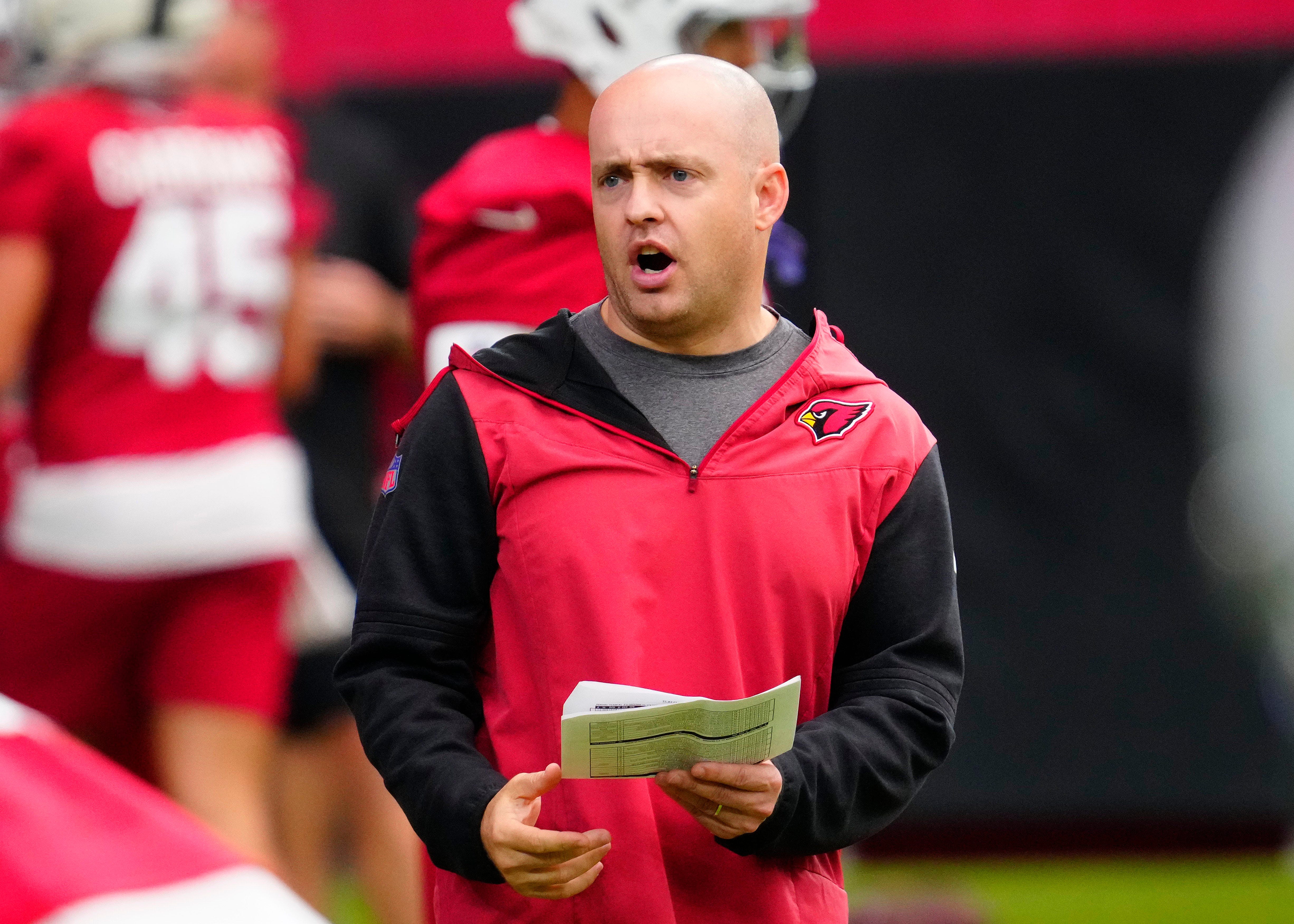
The noise never truly went away after 2024, and it’s only going to get louder.
Arizona Cardinals fans are understandably fed up with the dismal output of Drew Petzing’s offense, especially after a depressing 16-15 loss to the San Francisco 49ers on Sunday.
Preseason, the general consensus was reasonable. The offense should be (at best) a mild strength, or (at worst), a complementary piece to an exceptional defense.

But through three weeks, it’s been neither of those things. In fact, Arizona’s offense has repeatedly undone the work of said defense. The Cardinals got away with it facing two of the NFL’s weaker teams, but saw those mistakes come back to haunt them in their first taste of a divisional matchup.
Clearly, Petzing’s game plans and situational playcalling have left much to be desired. At this stage, that is undeniable, despite what head coach Jonathan Gannon may say about his OC.
But Sunday’s game showed more than just poor schematics.
Cardinals’ Schematic Issues
Before getting into the intangibles, the playbook should at least be addressed.
Cardinals fans and media alike are picking up on the same playcalling critiques. In the passing game, Arizona’s route trees are too simplistic, too slow-developing and too built on short, ball-control patterns. Meanwhile, the run game has been so nonexistent it’s hard to even look at the body of work closely enough to break down the schematic bones.
Too many times, the Cardinals have given up on a drive with a low-risk, low-reward play after any sort of negative yardage — penalties, sacks, etc.
But there’s also a notable rigidity that goes beyond the play designs themselves — one that is quite prevalent throughout the Shanahan coaching tree. The emphasis is not on playmakers, it’s on following a blueprint.
That outlook actually works well when dealing with limited personnel, as was painfully evidenced by Kyle Shanahan himself and Mac Jones on Sunday.
Think back to the Joshua Dobbs days of Petzing’s offense. The narrative then was about how surprisingly proficient a backup-ridden offense was at moving the football, even if it didn’t translate to wins.
Some would likely posit an implication that the blame lies on Kyler Murray. In a backhanded way, there’s an argument to be made there, but it’s not the same argument as the narrative that Murray simply can’t play.
Where the validity lies is in Murray’s actual skillset. A blueprint-focused scheme simply doesn’t work when you have a diverse group of skillsets — a pool of players who do specific (but different) things extremely well.
And that’s where Arizona’s offensive woes begin to go beyond the routes themselves.
Cardinals’ Woes Deeper Than Playcalling
Murray was hardly the main issue Sunday. He completed 22 of his 35 passes for 159 yards and a touchdown. If not for three drops by his pass-catchers, those numbers would have been significantly better. He took one sack for five yards, ran for 37 and did not turn the ball over. His 80.4 PFF grade was the highest among Cardinals’ offensive players.
Was he perfect? No. But with the game on the line, he delivered a pass to WR Zay Jones that hit him in the hands to ice the game — a pass Jones could not haul in.
The yardage is, however, concerning, and the yards per attempt (4.5) is even more so — though it’s been a recurring theme since Murray returned from his ACL tear in 2023.
The Cardinals rank 31st in the NFL in air yards per target this season, matching the eye test. But Murray himself ranks 4th in air yards when pressured (H/T Theo Mackie & Bo Brack on X/Twitter). Meaning, broken plays have allowed him to work outside the box of whatever conservative concept Arizona has installed.
And those broken-play reads have been there this season. Arizona’s offensive fireworks in 2024 mostly came on broken plays, as well. Murray has the skillset to make magic (yes, even downfield) when his first read is no longer an option and a checkdown isn’t available.
Murray isn’t checking the ball down because he’s scared. He’s being coached to take the checkdown when the main read isn’t there. And with the Shanahan style offense, there’s often only one read before said checkdown becomes a necessity.
Rather than allowing the franchise QB to take the reins and deliver improvisational results, Arizona’s coaching staff wants to live to run another play. That philosophy is perfectly fine when your bread-and-butter (the run) is working, and it’s fair to point out that Murray has also made some massive errors on broken plays in his career.
In Monday’s press conference, Gannon attributed those numbers to a lack of run game success, rather than de-emphasizing downfield passes. It’s not at all that the Cardinals’ coaches are specifically telling Murray not to throw deep. But it appears as if they would prefer the ball go to the safe option than let their elusive QB create something out of nothing.
It seems as if Arizona’s offensive philosophy is this: “Don’t do what you can do well, do what we want to be able to do.”
Which leads into Sunday’s next glaring issue.
What’s Wrong With Marvin Harrison Jr.?
“They’re just not using him right,” has been the cry surrounding Marvin Harrison Jr. since he arrived. That’s not totally untrue.
But the fact is the former fourth-overall pick is getting open. The results just aren’t falling. Sometimes he’s not being targeted when he should, but too often he’s simply dropping passes. That issue reared its head on Sunday, as an ugly drop cost the Cardinals a chunk play (and perhaps a touchdown).
Harrison has been known to body-catch. He did it in college, too. But those instances look more and more prevalent in year two, and the results are getting worse.
That type of issue isn’t skill-related, it’s a bad habit. Harrison can clearly catch the football with his hands. Body-catching is something that needs to be coached out of a young player. But with how often it continues to happen, the cause seems as if it comes down to a handful of possibilities.
1: He’s not coachable. That seems unlikely, given his NFL pedigree and the humility he’s known to display.
2: He’s not being given the proper coaching. With an offense that emphasizes everything but wide receivers, maybe there simply isn’t enough focus on developing his game.
3: He’s being coached in the wrong direction. No, the coaches probably aren’t telling him to catch the ball with his forearms, but bear with this thought:
The Cardinals want contested-catch ability. They want to throw the ball to sure-handed tight ends. A tight end or a big-bodied wide receiver catching a football is more about using their body and center of mass against a defender than plucking the ball out of the air in stride and moving in open space.
Harrison bulked up over the offseason. He clearly tries to leverage himself against defenders, but isn’t coming away with the contested catches. Once again, the Cardinals seem to want Harrison to fit what they prefer to do offensively rather than utilizing his own unique skillset.
The other factor is confidence. Clearly, Harrison’s is understandably low. And the toughest part of that fact is there are easy ways to help a young wideout gain confidence — but doing so would force Arizona to slightly deviate from its offensive philosophy.
Sunday’s loss was a tale of poor execution by numerous players, absolutely. But when an entire offense is based on asking players to execute on the opposite end of their skillset, it’s easy to see how those necessary plays don’t come to fruition.
How many plays has Jones even expected the ball to come his way? How many offensive snaps has Emari Demercado even played in 2025? How many times has Harrison seen the ball come to him when wide open?
Not to make excuses for NFL players. They each know all too well they should have executed Sunday. But it seems as if Arizona’s offensive approach has nearly nothing to do with the players themselves. It’s not just what plays are being called, but rather looks like a lack of willingness to make changes.
If some types of adjustments aren’t made, it’s going to be a long season, especially in the NFC West.
Comments
Share your thoughts
Join the conversation

The Comment section is only for diehard members
Scroll to next article

Don't like ads?
Don't like ads?
