

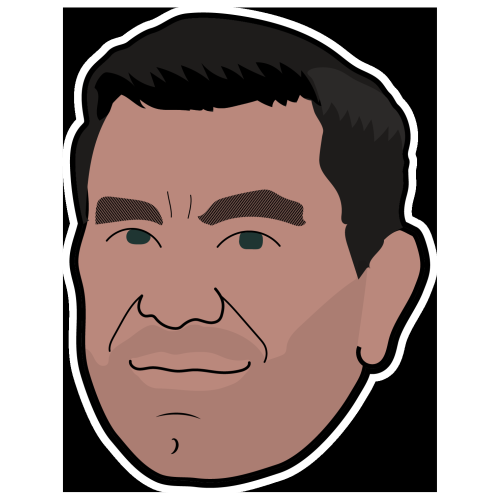

The Bill Masterton Memorial Trophy has been awarded annually since 1968 to the NHL player who best exemplifies the qualities of perseverance, sportsmanship and dedication to hockey. There is no player on the Coyotes’ roster who has had to persevere through more trials to stick with the game he loves than goalie Connor Ingram.
Ingram entered the NHL/NHLPA player assistance program on Jan. 25, 2021. He had undiagnosed obsessive-compulsive disorder that led to alcohol abuse, anxiety issues, loneliness and a tendency to shy away from contact with others.
“I think everybody goes through their own struggles in their own, different way,” Ingram said. “Mine just happens to be weirdly public.
“I didn’t choose for it to be public. The program seems to be pretty selective on what gets published and whose story gets published. For some reason, I was one of the guys that got blasted all over the internet so there’s no hiding after that happens. At that point, I wasn’t gonna sit here and tell you it didn’t happen. Why not just try and make it a positive?”
Ingram has done just that. While he says there will always be elements of his disorder present in his life, regular therapy, “the tools to cope with it,” and the support of his parents, his girlfriend, Sarah Mitchell, and his German Shepherd, Loki, have helped Ingram find a happier place off and on the ice.
“You’ve got to give credit to the people around, whether it’s Schwabby [goalie coach Corey Schwab] or Bear [coach André Tourigny] or even [GM] Bill [Armstrong] taking a flier on a fat kid on waivers,” he said. “It took a lot of steps to get here and it’s been a ride. There’s no doubt about that.
“What Sarah has brought to me is incredible. She takes care of me when days aren’t good and when things are good, she’s right there by my side. She’s been incredible and she’s been a huge light in my life to help figure things out. I know if I decide I never want to play hockey again tomorrow, she’ll ask, ‘What’s next?’ She’s in it for the long haul. It’s hard to put into words what a person like that means to you.”

Ingram has no immediate plans to abandon his lifelong passion. While there is plenty of room for growth ahead, he has established himself as a regular NHL goaltender. He entered play on Friday with the NHL’s 13th best save percentage (.909) among qualified goaltenders, and the 10th best goals saved above expected (18.14).
“I’m having fun,” he said. “This is what you work your whole life to do. In 27 years I’ve never had a real job. I don’t know how to make a résumé.”
He is also impacting people by telling his story to multiple media outlets over the years, beginning with a lengthy piece for The Athletic while he played in Nashville.
“It took a while for me to share my story,” he said. “It goes from me being locked in a hotel room in Nashville and the whole world thinking you do cocaine nine times a week to being able to tell your story the way you want to. There’s definitely highs and lows, and there’s definitely people that only know my name because they think I was a raging heroin addict in 2021. But I mean, that’s how it goes. I’m comfortable with it. I know what went on. So to deal with it the way I do now, I think it helps people.”
Ingram has witnessed that firsthand.
“The amount of people who have come forward and just been like, ‘Hey, I got my daughter into therapy because of you.’ Or, ‘Hey, you made me think about some things and get help;’ that’s pretty eye-opening,” he said. “It feels good to impact people.
“I’m not a person who likes doing these kinds of things or being in the public eye, but if we’re going to talk about it, why not make it a good thing? You’re trying to save lives. There’s a breaking point for everyone so if I can be an influence like, ‘Hey, if that guy did it, I can do it,’ why not do it?”

Ingram is the Arizona chapter of the Professional Hockey Writers Association’s 2024 nominee for the Bill Masterton Memorial Trophy. Unlike most players, he actually thought about this possibility before the chapter nominated him.
“It’s super exciting,” he said. “Slowly over the year, it became a goal of mine and to do it and to be recognized is big. It kind of shows that while you have dark days in your life, there’s always a way out and there’s always a light at the end of the tunnel. To kind of get some recognition that you’ve put in the work and you’ve done what you’ve had to do and now it’s going well for you is big.
“But this is not for me. It’s so other people can say ‘Hey, man, look. Life sucks right now, but let’s figure it out.’ I think this is a great way to prove that there is light at the end of the tunnel and you can get through it and you can do it. So why not try?”

1 Comment
Robert
Excellent article Craig
I was in therapy for just a few months from this excellent fellow in Gilbert.
The anxiety problems that I have and always had ruined many a job and relationships.
I’m glad to see Ingram addressing those problems and hope he stays with it.
Just driving to Coyote games for all those years were sources of extreme anxiety..just the thoughts of what could ( and as the therapist pointed out) do happen in between here and there.
But I was once a devoted fan.. so, what I’d do is do things just before leaving that insured everything would be ok.. in my case, I took out my trash and cleaned my bathrooms just before lay for each game….( Ingram and the water bottles)
Once in high school I was lucky enough to get a date but trying to look ahead at any potential breakdowns, I write down in a notebook every potential thing that could happen and what I’d do if that event occurred.
I concluded that there were potentially more things that could happen , than I’d be prepared for so I called up and broke the date.
These same weird anxieties followed me in all of my life’s experiences.
My dad knew about them and just would not accept the weirdness of these un-manly problems
In the end he probably helped more than he knew because I worked hard to overcome them … ( you never do)
In the end I stopped seeing my therapist in Gilbert because I didn’t want the visits reflected on my record. I paid 150 bucks, every two weeks out of pocket and finally stopped going.
My lifestyle as a distance runner fit right in with my mental situation.
Train like an animal, eat, recover, then repeat… for 47 years so far.
I’m amazed that in my condition, I attended 300 NHL games … every time I made it home, it was glorious!
Conner, you’re not alone!!!
Anxiety and compulsive disorders affected every job and relationship that ever had… adversely
I would have stayed in therapy but one session the therapist said “ sooner or later you’ll have to figure out what you want out of this”””
And so, I left. Ha
Good job Connor Ingram!