© 2026 ALLCITY Network Inc.
All rights reserved.


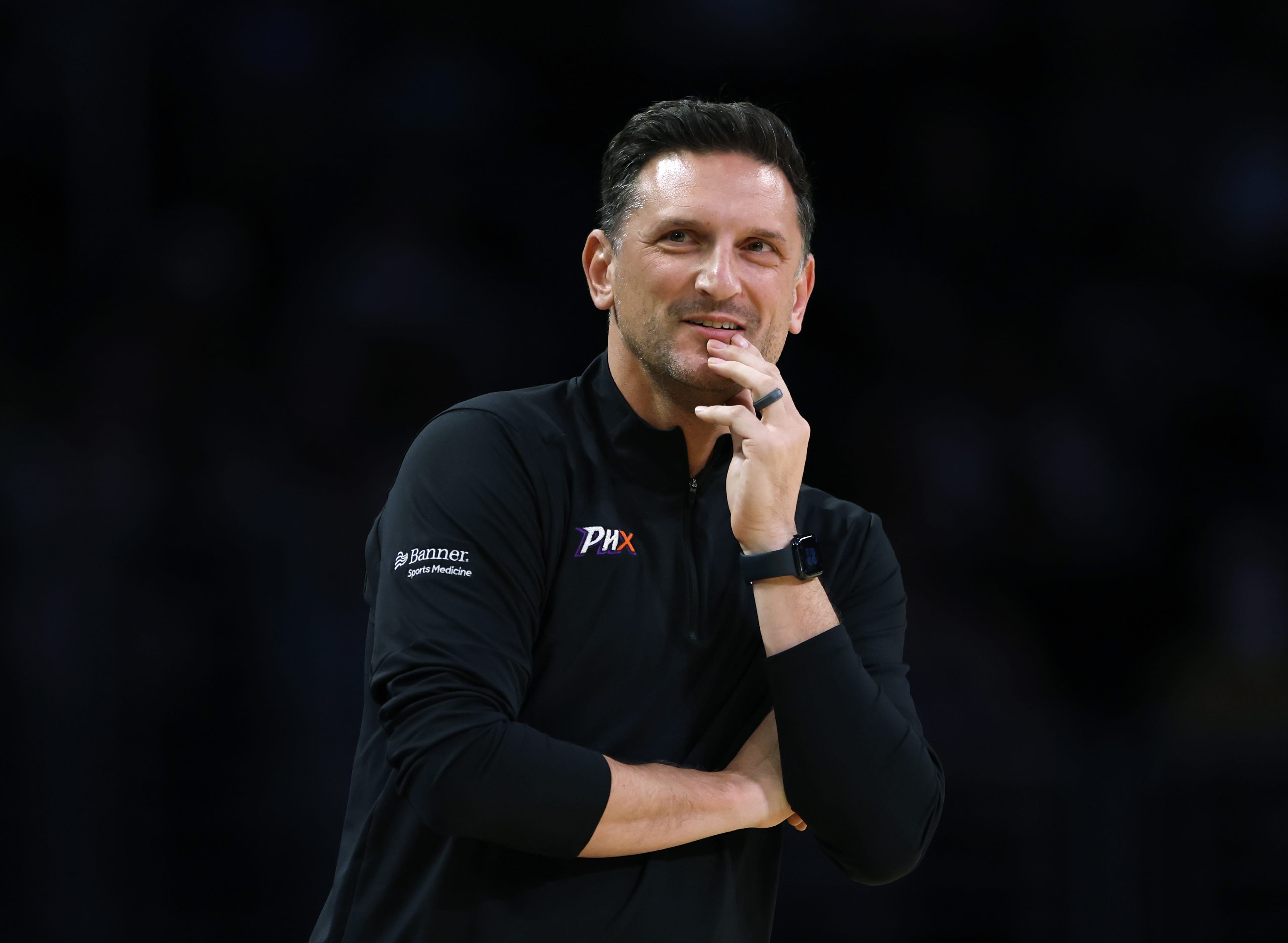
The “principal’s office” is tucked between the weight room and the practice courts at the Mountain America Performance Center. It is where, after Phoenix Mercury practice, all players and staff start their walk toward the parking lot and back home. It has all the qualities you might remember from school: fluorescent lighting, overstuffed bookshelves, and a small table for guests.
The “principal’s office” is what head coach Nate Tibbetts tells me the team calls his office. It is where he invites players in and does the work — the hardest work — of coaching. Not on the whiteboard behind his desk, but face to face. Talking, learning, understanding.
“It’s a pleasure to see our players each and every day,” Tibbetts tells me. “We’ve got 11 or 12 players, I would say seven to 10 of them come in and it’s, ‘How was your day?’”

These are the building blocks of a Tibbetts-coached team. The conversations.
Tibbetts came up as a coach’s son in a place where playing basketball might make the people look at you funny. It was Sioux Falls, South Dakota. Population: just over 100K. He lived and played there through college.
A small town in a sparse state, it’s the type of place where everyone more or less knows everyone. The basketball circles ran even smaller.
“South Dakota’s a really small state,” Tibbetts’ old friend, Matt Wilber, tells me. “You get to know people and you’re connected together.”
From afar, Wilber could see Tibbetts getting through to his teammates in a way that being a point guard didn’t fully explain. Once they ended up on the same staff at the University of Sioux Falls, Wilber got it.
“It’s something to be envied,” says Wilber, now a coach at Division II Northern State. “He just has this infectious personality about him.”
The two of them started a training facility together, Tibbs Basketball. Tibbetts split time between that facility and another, where his father coached the girls’ team at local Roosevelt high school. That’s where he got linked up with Dave Joerger, the man who would ultimately hire him as an assistant for the Continental Basketball Association’s Sioux Falls Skyforce.
By 30, Tibbetts was the head coach of a pro team in his hometown.
But that headstart made way to a grueling second act. Tibbetts jumped around in the NBA D-League for a few years before landing in Portland with the Trail Blazers. In Tibbetts’ eight years there, the team averaged 46 wins and made the playoffs every season.
In Portland, Tibbetts not only vaulted from third assistant to associate head coach but learned how to put his infectious positivity into practice. Longtime friend and colleague Dale Osbourne recalls a bus ride during a losing streak when even a low-level team trainer fell victim to a Tibbetts pep talk. Osbourne remembers Tibbetts, smile on his face, likening the trainer to a vampire and demanding a positive outlook.
As part of a perennial winner and respected organization, Tibbetts was a natural candidate to run a team. The interviews came, but the offers did not. He got close in Memphis and then again in Atlanta, only to fall short.
“You work so hard for that opportunity and you don’t know if they’re going to pick you or not. And then they decide to go the other way, it does eat at you,” Tibbetts tells me. “And then I think there’s just a cycle in the NBA, like life or other things.”
So Tibbetts hitched a ride to Orlando. If a head coaching job in the NBA had passed him up, he at least wanted to control his destiny. With No. 1 overall pick Paolo Banchero in tow and widely respected head coach Jamahl Mosley in charge, Tibbetts figured he would be comfortable.
It didn’t look like quitting to Osbourne, who saw Tibbetts continue to grow as a head coach. With a younger Magic group, Tibbetts found new ways to cut through to his players and build them up.
Osbourne recalls a confrontation, middle of a game under the lights, between Tibbetts and a player who Osbourne describes as being from “the inner-city.” With the player beelining it back to the bench in a mood, Tibbetts wanted his ear. The player kept it moving.
With a little more gusto in his voice, Tibbetts commanded: “I’m not done talking to you.”
“That player responded to a guy from Sioux Falls, South Dakota,” Osbourne chuckles now.
“The biggest reason that kid responded is because Nate is huge on communication and building relationships and trust. He figured out, as a coach, that you can be the greatest coach when it comes to Xs and Os, but if your players don’t trust you, it doesn’t matter what you draw up on that drawing board.”
After two seasons and a playoff appearance for the young Magic, a different conversation proved valuable to Tibbetts. A rival was holding out a hand.
The reason Tibbetts’ Portland teams never made good on their talent and continuity is that they peaked at the same time as perhaps the greatest team that the NBA has ever seen. Like so many Western Conference coaches and players in the 2010s, the most fruitful period of Tibbetts’ professional life smashed directly into the Golden State Warriors dynasty. Golden State beat Portland three times in four years during the dynasty, including two sweeps.
During those duels, Tibbetts got to know a basketball operations ace for the Warriors named Nick U’Ren. When Golden State had an opening on its staff in 2018, Tibbetts even interviewed to join the best show on the hardwood. Nothing came of it.
Until 2024, when Tibbetts got a call out of the blue from U’Ren:
“I told Lindsey (Tibbetts’ wife), ‘He was just named the Mercury GM.’ I wonder if he’s calling about their coaching job.”
It was.
More serendipitously, Tibbetts’ mother was in town visiting. It was as if the memory of his father was there to nod his head, take the job.
Tibbetts called U’Ren back within the evening. Within days, he had signed a contract to be the next head coach of one of the WNBA’s most iconic franchises to become its highest-paid coach, a career turn that even he had never anticipated.
“I don’t think he was expecting that phone call from the WNBA, and I wasn’t expecting it either,” Osbourne says.
But with viewership on the rise, investment flowing in and arenas filling up, this wasn’t the career decision it used to be. Tibbetts would have the resources in Phoenix to get to do his job the way he wanted and coach championship-caliber teams.
There were numerous reasons to be excited. Phoenix was a great place to raise his growing family. And unlike rebuilds he would have taken over in Atlanta or Memphis a decade prior, Tibbetts was getting a fast track to a contender. With the Mercury, he would be coaching Diana Taurasi and Brittney Griner and Kahleah Cooper, WNBA champions.
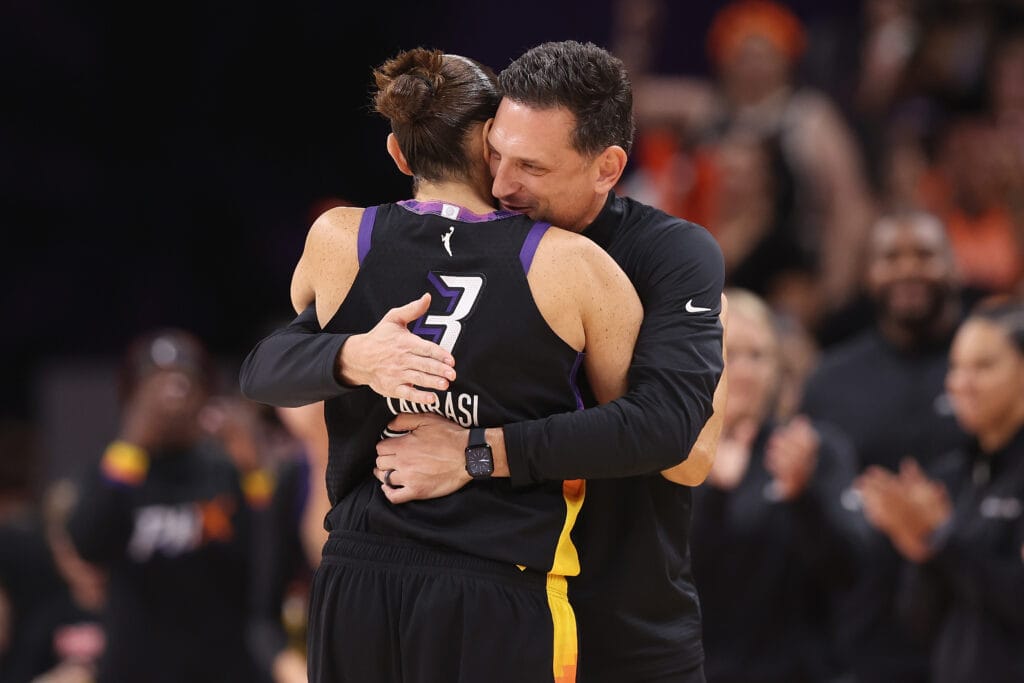
“I have a lot of respect for him to do it. I’m quite sure that behind closed doors there was people who were like, ‘Why is he doing that?’” Osbourne says. “But when you look at the WNBA now, it’s an up-and-coming league. This is one of the most exciting leagues on TV. With the players they got now, with the crowds that are coming to the games. The timing for Nate, I think, was perfect for him to be involved in it.
“He didn’t look down on it as if it was something negative that a WNBA team called him. I’m quite sure he was shocked, but I promise you that as he thought about it and he talked about it, he got more excited about it. Because during the whole process, I could tell this was something he was really thinking about and wanting to do.”
Tibbetts moved to the Valley early, before his family came out. Sleepless nights at the team facility became a crash course in WNBA hoops.
The other order of business to get ready for his new life in women’s basketball was another conversation. More specifically, a meal with Diana Taurasi.
Meanwhile, the conversation around Tibbetts turned sour. League faithful questioned the Mercury’s choice to hire someone with no WNBA experience and give him a reported record payday of $1.2 million.
“I hope that puts the pressure on the other owners to pay the other coaches more, to be quite honest,” Tibbetts says.
The next item on Tibbetts’ to-do list was hiring a lieutenant. He brought Wilber to Phoenix as an assistant, to have someone he knew around. Tibbetts needed to fill in what he didn’t know. At the top of his list was Kristi Toliver, a multi-time WNBA champion player and experienced NBA assistant coach.
“I needed someone that had played and coached,” Tibbetts says. “That was what was hard for me, is coming over, I didn’t have a big circle of women coaches. So being able to call NBA people that I knew and trusted, had coached with KT, she was the No. 1 person that I was after.”
In a best-case scenario, he would only have her for a season. He wanted to make the most of it.
Toliver played in Russia with Taurasi and Brittney Griner. As associate head coach, she was the perfect liaison between the legendary team Tibbetts inherited and the structure he was used to.
It helped Tibbetts, the smiling NBA lifer, get on the same page as the women he was to lead.
“I think women, from my experience, I’m always very thoughtful in what I say because I want to treat people with respect no matter what,” he says. “But I think men have a tendency to move on from a situation or you saying something that may affect them. I think women tend to hold onto things more.”
That’s where Toliver came in. And for the recently retired scoring point guard, it was a sweet landing spot after losing what would become her final season as a player to injury.
“Talking with Nate the first time, never met him before, obviously in the NBA we’d seen each other from a distance,” Toliver told me last year on The Just Basketball Show. “We just didn’t have a connection on that level, in that setting. But our connection was immediate as soon as we got on the phone. I think he’s excited for the opportunity, I think this is a perfect position for me to be in.”
“Fourteen years of WNBA playing experience, knowing the league, knowing the players, knowing the routines and how things go, to me, it’s a great match. He’s a great guy, he’s fun to be around, he’s fun to work with. You never know when you go in and something’s brand new if something’s going to connect, and we have from the jump.”
Tibbetts tasked Toliver with leading offensive gameplanning and player development in addition to being one of the key communicators in the building day to day. Not only was he prepared to lose her to another team as head coach, he hoped for it.
“We should have,” he says. “I kind of told her, just because those teams didn’t get it right, I’ve been through what you’ve been through. It happens. They’ve gotta make a choice. You’re ready for it, but they’ve gotta choose you and they made the wrong decision.”
Toliver remained his top confidante and copilot throughout a summer that saw Taurasi retire, Griner depart, and the Mercury bring in superstars Alyssa Thomas and Satou Sabally as reinforcements. They traveled to Miami and Europe to recruit. Getting new star players meant saying goodbye to the core of last year’s team. It helped to have a strong right hand. Their relationship reached a new level.
“I view her as like a sister now. She may view me as an uncle,” Tibbetts jokes.
This year, he has had to navigate the season without her. Toliver has been away from the team much of the year dealing with a personal matter.
It has been important to Tibbetts to show Toliver that she is supported and can take her time to return. “I don’t know if every organization would,” Tibbetts says. Still, she remains just an arm’s length away as Tibbetts leads the Mercury to new heights.
“Every time I’m driving to the game, she’s the call that I make,” he adds. “But it’s also been an opportunity for some of our staff members to step up.”
Nearly all of the Mercury roster turned over last winter. The team that has surprised the league in 2025 was questionable beneath Copper, Thomas and Sabally. Four rookies are in the rotation.
With that front of mind and championship expectations looming in the back of mind, Tibbetts poured into Copper. Not simply the only returning star player, Copper represents much of what the Mercury want to be.
She chose them in 2024, yearning for a franchise that would embrace and invest in her after years in Chicago. Then, she had the confidence to take the baton from Taurasi and run with it. Whether by deferring to Copper on clutch baskets or pumping her up on-camera, Taurasi gave her stamp of approval. Copper has the brash personality, pretty offensive game and killer mentality to keep the Taurasi legacy alive in Phoenix.
What Tibbetts wanted out of Copper, though, was to see her lead. In an emotional response at media day before this season, Tibbetts described the pride he felt in watching Copper meet the moment as the face of the Mercury.
“I think this is why you get into coaching,” Tibbetts said. “Kah is special. She means a lot to me and what we’re trying to do. And her growth, over the course of the year, I mean sh*t a year ago we had just met for the first time. Our conversations, our relationship, our trust is at the ultimate level.
“There’s going to be good times and bad times in any relationship. But we have a new group (and) my whole challenge to her this year is lead, lead, lead. It’s not just with what you say, it’s what you do.”
Within minutes, Copper stole a microphone and, with her reporter hat on, asked a question of her coach. As if having read his mind, she asked him about how he was encouraging “Kahleah Copper” (her, of course) to be more of a leader.
Talk about being on the same page.
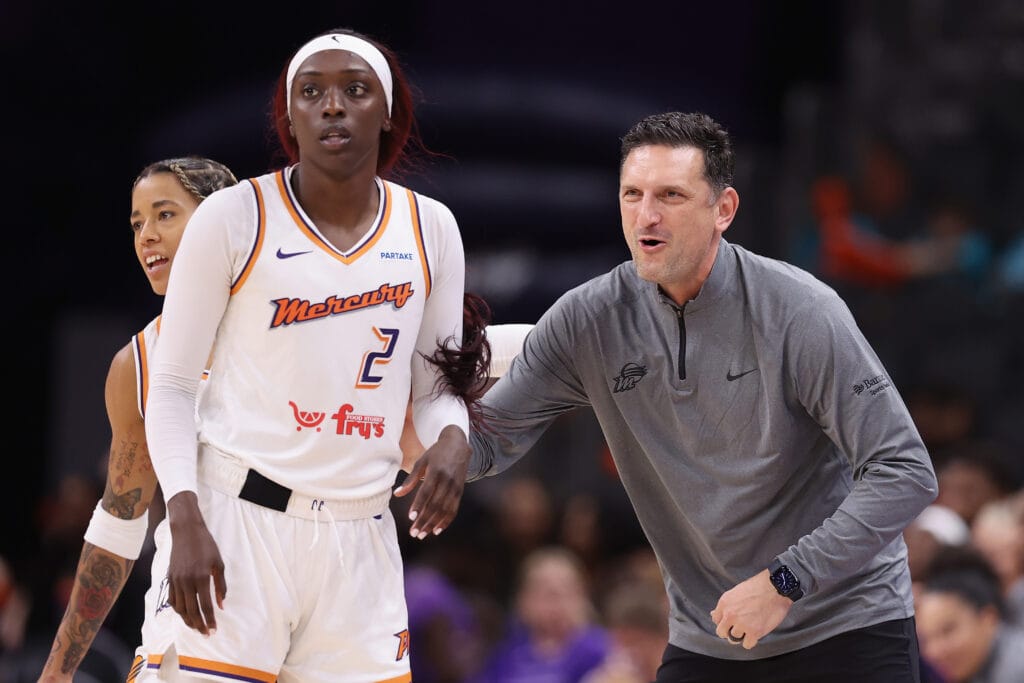
It hasn’t been easy, though. Copper missed the start of the season after knee surgery and has been limited to just six games so far.
Even without her, the Mercury are off to an outstanding start. In his first season, Tibbetts threw a lot at players. He learned he could not expect players to cover as much ground on defense or execute the same plays as he did in the NBA.
This season, Thomas in particular has unlocked new schematic possibilities. With the perennial MVP candidate, Tibbetts can begin to build in a level of creativity and feel that he wants to be a staple of his program in Phoenix.
“I want to give our women freedom,” Tibbetts says. “I don’t want to tell them, on every possession, you’ve got to do this, this and this.”
In perhaps the biggest testament to Tibbetts’ relentlessly positive, people-first style, the Mercury are a chemistry team. They are a chemistry team in spite of the fact that they had precisely zero of it before camp. They play together, on both ends, and beat people as the sum of their parts rather than their individual brilliance.
It should not be possible, and yet Tibbetts has helped make it so. Asked what he makes of his team playing so well together in spite of their inexperience, Tibbetts hardly knows how to answer. Of course, he won’t take credit for it.
“It’s just a credit to the group,” Tibbetts says. “We’ve had people in and people out, and whoever’s been available has competed at a high level and we’ve had different people step up.”
Osbourne gets to hear the awe from Tibbetts about how it’s coming together. There’s no bragging on their phone calls, either. Tibbetts is simply proud to see that what he is putting into the team is showing up on the court.
“All coaches are going to say this, but he was on the phone with me the other night saying, ‘Coach we play so hard,’” Osbourne says. “And that’s half the battle right there. His teams really play hard. I think he knows that.”
With big wins over Minnesota and New York in recent weeks, the Mercury are on the short list of the teams that will matter in the fall. They have the star power, the depth and the resume to prove it.
Tibbetts is assured of the process, but not ready to look ahead. Fans and media have grown used to hearing Tibbetts root for tight games. Not losses, ideally, but tests. Games that make this group feel the sweat on their necks or the tightness in the throat and prove they can handle it.
The difference between this season ending with a trophy or not, Tibbetts says, is not talent or tactics. “I don’t think any of us know for sure where we’re headed, just because we haven’t been together yet.” The difference is togetherness. Doesn’t that sound like exactly what he would say?
The sprint to the finish line for the most ragtag Mercury team ever in the longest WNBA season ever is going to be about connecting. Stacking up the time spent — clutch wins, dinners as a team, or those trips to the principal’s office — to something bigger.
Then, maybe, they will be ready. It’s what Tibbetts has always been going for, pushing up through every level to build it.
“When you see the team playing with this team-first mentality and it’s about us and it’s about us and it’s about us, and they play with that kind of energy and they play as a team, that is Nate Tibbetts to a T,” says Wilber.
“From what I’ve seen from him as a point guard to a coach to a pro’s coach, I think everywhere he’s been, you can probably go back and see there’s been a strong culture established and his name and his footprint has been on it. And you see with the Mercury, him leading that.”
“This energy of ‘us,’ that is a Nate Tibbetts trademark.”