© 2026 ALLCITY Network Inc.
All rights reserved.



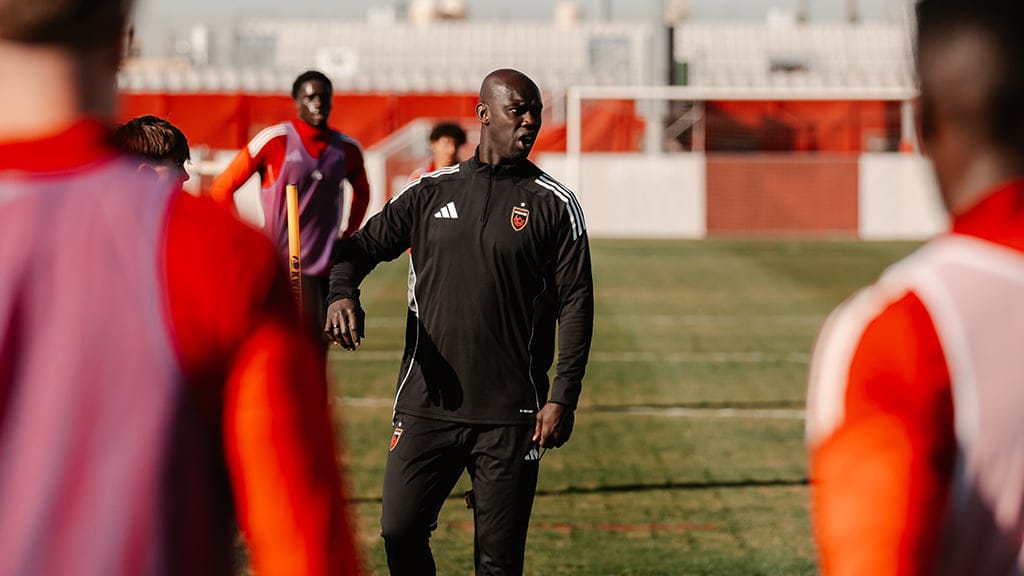
Like most parts of Phoenix Rising‘s stadium, Pa-Modou Kah‘s office is basic.
On one wall sits a large calendar of the coming weeks. On another, a diagram of a football pitch with 22 markers representing players. There is a desk, and a couple of chairs. There’s no natural light.
It isn’t a large room. In honesty, it feels small.

Just half an hour earlier, Rising’s coach was as loud as ever on the training ground, alternating between critiques on positioning one minute and joining in with jokes the next. That is the Kah that most Phoenix fans have come to know: sometimes intense, sometimes fun, yet always with a voice that could travel for miles.
But as I sat down with Kah in his office, a different picture emerged. It was the image of a young boy, after traveling thousands of miles, landing in Norway for the very first time.
“You grow up in Africa being outside, right?,” he said. “Just for starters, being outside, sun. Then you go to a place in winter. It’s completely dark. Snow falling. I had never seen snow. I remember landing at the airport and coming out and just seeing the snow. I touched it, and it turned into water, and wow, what is this experience?”
The eight-year-old Pa-Modou Kah didn’t know it at the time, but that was just the first time in his life that football would take him to a completely different part of the world. Ahead of him lay a story of national team caps, trophies as both a player and a coach, and more recently, to the head coach position at a football club in the Sonoran desert.
A long way away
From the very beginning, Pa-Modou Kah was surrounded by sport. His mother, who raised him in his youth in Gambia, played basketball for the national team. His father was a footballer, playing midfield at an international level too.
“Gambia was not as well known [in football] as now,” Kah said. “Now we have a lot of footballers, and part of it is my Dad’s generation and the pioneers who left Gambia for, for better or worse, us. […] They opened the door for us. The national team went to Norway, and one team liked him called Skeid, and he saw an opportunity to have a better future for himself and for us as a family.”
At the age of eight, Kah left for Norway. In some ways, it was a challenge for him to adapt, and not just because of the change in scenery. His father wasn’t a stranger, but he hadn’t lived with him in his earliest years. His mother wouldn’t join the rest of the family in Scandinavia for another four years.
“There were definitely times where I missed my mum, I missed my cousins,” Kah said. “I missed being outside playing barefooted. That’s something I could not do in Norway, because during winter time, I would have froze to death. That was a little bit different, but also you have to make new friends. It’s not always as easy as people think, but due also to sport, that helps.”
As a young child looking to make new friends in a completely different country, footballing ability certainly didn’t harm him. Neither did his talent with languages; by his estimate, he’d picked up the Norwegian language within about three months.
But that footballing talent wasn’t always accompanied by the desire to push on to the top. He didn’t feel pressured to follow in his father’s footsteps, who only demanded his son work hard, be a good person and work out what he wanted to be for himself. So, as a teenager, the future Phoenix Rising coach almost fell out of the game altogether.
“Every kid dreams of making it, but I remember I quit at 14 because I was not having fun,” Kah said. “It was not fun any more. But then you go, you want to find the light again.”
He would, just about a year later, while playing against his best friends. Those friends played for Vålerenga, and Kah was asked to try out for the squad himself. After making the team, he was told by his coaches: play well, and you will train with the first team.
At the age of 19, Kah made his top flight debut with the club. He would go on to make almost 100 league appearances for Vålerenga, including starting in the 2002 Norwegian Cup final, which his side won 1-0.
Yet while football had become Kah’s career, it wasn’t at the expense of his education. His father was clear: he hadn’t brought Pa to Norway for him to be a fool.
“My father was very adamant for it,” Kah said. “I remember, I was about to go sign my first professional deal. He didn’t speak, didn’t say much. The only thing he said in the meeting is ‘yeah, everything is all good, but what’s happening with the school?'”
The result was a balancing act. Kah was not just a professional footballer, but also a student, simultaneously studying for a degree in engineering.
“We played Wales in the under-21s,” Kah said. “I had to do an exam on the Friday. An exam. The teachers, you know at that time there was no internet, so they gave the work to the head coach and I had to sit in a room with the head coach and had to do it. Those were the times. You weren’t doing it over Zoom.”
Kah credited the work ethic instilled him by his parents for managing the workload, and took those lessons on the importance of his own education with him as he’s worked with younger players in Phoenix. One, Braxton Montgomery, left for college last summer after becoming a regular fixture in the first team. Many more will face similar decisions over the coming years, in no small part due to the sheer number of academy products being introduced to league and cup play.
“You want to guide them in terms of making them understand that yes, you are a footballer for an hour and a half, but you are still a human being that has to do human being things,” Kah said. “I know it’s very important for parents for kids to have a degree, so I’m not going to sit there and say don’t do it when I have done it.
“Sitting and talking to Braxton and understanding that he can become a pro, but his desire to experience college… You have to support that, and for me, it was the natural thing to do because I went through that phase but just in a different way.”
“What gives another human being the right to say these things?”
Just as Kah moved up the ranks in the club game, he did similarly in the international scene. After several appearances at age levels, he made his full international debut for Norway in 2001. Looking back at his career, he cited representing his country as one of the best moments.
But being in the national team didn’t shield him from something that he has seen in some form across every country he’s travelled to: racism.
“I’ve experienced it everywhere, but I also experienced it in Norway, when I didn’t want to sign my contract,” Kah said “I’ll never forget. 2003, I decided that I’m not going to renew my contract, and we went in January for a national team camp. They had something new where fans can connect with players through emails and stuff like this, that our players union set up. Well, they had to stop mine because of the hateful messages that I was receiving from my own fans.
“That was definitely an eye opener, because it was my country. You think you will not receive it. Afterwards, it was a big regret from the fans, but I forgive. That’s just who I am. I don’t forget, but I forgive, and I move on. I think the best way is to keep moving forward and not let them win, because if you stop, they win.”
Kah described the abuse as difficult to deal with at the time, but that he made it through with the encouragement and support of his father.
Yet while pushing through may have been his approach at the time, Kah’s changing role in the game has also changed some of his perspective on how to manage those situations.
“If that was what happened right now, I would tell my players to walk off the field, because there is no place in the game [for it],” Kah said. “What gives another human being the right to say these things? I can understand in the game if it stays in the game, but the game is not about my color or your color. The game is about the shirt that we’re defending, our love of the game, to bring joy to the fans. Your job is to support your team, and not the color of skin. Your team. To see it happening still now, that means that we’re going backwards in society. We’re not going forwards.”
Racism remains a serious problem in football worldwide, despite some efforts from governing bodies to eradicate it. Abuse isn’t limited to coming from the stands either, with incidents occurring on the field too.
Last year, Hartford Athletic walked off the field in Pittsburgh alleging that one of their players had been racially abused by an opponent. In 2022, future Rising defender Laurence Wyke was found guilty by a league disciplinary panel of making monkey gestures at a Black opponent, although the decision was overturned on appeal due to lack of evidence and Wyke has since filed suit against USL for defamation.
In Europe, headlines were made in the last month after Real Madrid’s Vinicius Jr alleged racial abuse in a Champions League clash against Benfica. It’s something that Kah commented specifically on: his disappointment at the excuses made by Benfica coach José Mourinho for the conduct, and the cowardice of a player saying things with their mouth covered. The latter has since gained the attention of the International FA Board, which sets the Laws of the Game across the globe.
“Sport is sport,” Kah said. “Sports don’t see no colors, right? Society does, and that’s why now you look back and yeah, it’s a shame that as society, we haven’t truly progressed the way that we could have with all this technology and all these things that are available to us as humankind. So, it is a little bit sad, but it’s up to us and the newer generation as well to try to change it, and I think the newer generation are doing it in their own ways. But change is the toughest thing for any human being, to want to change, because change makes you uncomfortable, and I don’t know if everybody in society really wants to be uncomfortable.”
So how do we as a society change things?
“I think there’s a lot of good things happening, but as we know as human beings, negativity is what sells, right?” Kah said. “Good things don’t sell, but if we want to progress, we must sell more good things happening, because then we go back to having real values as human beings and helping each other.
“Me and you, it’s crazy. We’re bonding over a country and football. We’re bonding over a country and football. You don’t know me. I don’t know you. But we have love for Wales, and we have love for football, right? It’s not that I’m Black and you’re white. The more things we do, the more we also help the new generation understand because you look at it, if you go to a kindergarten, they cannot see colors.”
Kah’s legacy back in Norway also shows an example of progress. He wasn’t just another player to make it to the top, represent his country and earn ten caps. He was the first fully Black player to suit up for Norway in football, and left a legacy for many other players from similar backgrounds to break through.
“I never thought about it, truly, until one of my friends came to visit,” Kah said. “We were just chit-chatting, him, my wife and I, and he kind of brought it up.
“He goes: ‘You have no idea what you have done, have you?”
“Football is not a rich man’s sport”
That Norwegian national team has now qualified for the World Cup for the first time 1998. Conveniently, Rising has been given a bye week by the league during the competition’s group stage.
“I’ve got a couple of teams I need to go visit,” Kah said. “I’ve got Haiti. I’ve got Curaçao. We’ve got Norway, Holland. We’ve got Canada. So it’s multiple choices. For me, it will be great, especially for my daughters who were born in Canada to see their Uncle Fonzi (Alphonso Davies) play. I think that will be beautiful, but even for us watching Norway will mean a lot.
“It’s more for my kids than it’s for me, because I got to go to the best World Cup ever, which was 2010 in Africa. Nothing tops that for me when it comes to tournaments, and to be able to do that with my wife and my father was unique. Just to see how emotional my father was and what it meant to him, and it meant a lot for me then.”
2026 isn’t just an opportunity for his own daughters, though. To Kah, the World Cup offers an opportunity to showcase the sport to a new generation of football.
“Speaking now as a coach, I would love to see a lot of young players actually go, see the World Cup, feel it, live it, to understand what it takes if they want to achieve their dreams, Kah said. “I want to see a kid that we may not know of be inspired by the World Cup. That’s what you want.”
But that potential legacy is at risk. For many, the pricing of the 2026 World Cup has shut them out. Tickets are being sold by FIFA at prices several times that seen four years ago in Qatar, and even parking spaces are being sold for hundreds of dollars by the organizers.
Kah admitted he can’t speak to all of the factors at play when it comes to price increases, but that still didn’t stop him from expressing his disappointment at its impact.
“Do we still want to see that growth [for the sport]?” Kah said. “Well, then we should make it accessible for people, because football is a poor man’s sport. Football is not a rich man’s sport, unless you’re in this country. That’s where now you can look at it and alright, in this country, it’s about money.”
Legacy doesn’t just come from attending games, though. For the first time, the World Cup has been expanded to 48 teams, offering an opportunity for countries that have never been able to grace the highest stage to have their moment in the spotlight.
Recently, former U.S. goalkeeper Tim Howard criticized the number of places allotted to CONCACAF, the confederation representing North and Central America and the Caribbean. He saw it as diluting the tournament, something Kah strongly disagreed with.
“To speak about teams like Curaçao and all of them [that they should] not be able to qualify… You should embrace those teams qualifying, because we get to see players fight for their dream, which is to make the World Cup and their country proud,” Kah said. “Who are you to diminish that? He’s been to what, two, three World Cups, so why is the World Cup only for the top? Because he put out a comment that teams like Curaçao should not qualify, or Haiti. Why?
“I like what [FIFA President] Gianni Infantino is doing [in expanding the World Cup]. That’s what we needed. It’s not only for the top that we want to see the World Cup. We don’t. For me, it’s not. Sometimes you get bored of seeing only the same teams. I want to see new teams, because football is played everywhere, so why not give those people the opportunity as well to showcase their country, showcase what they are good at?”
Kah in Phoenix
For now, though, the focus is here in Phoenix, on the Rising team that he coaches.
I asked Kah if he ever came to the training ground with lessons he’d learned from raising his young daughters, eliciting a laugh from the coach.
“People can say we deal with children, even at the highest level,” he replied. “Even the likes of Cristiano Ronaldo and [Lionel] Messi, you’re dealing with them. They’re human beings, but sometimes they’re in a position where we do forget reality, because we’re put on a pedestal.
“We’re nothing special. A policeman is special: he has to go save lives, when he does it right. A fireman, a mine worker, a parent who has three jobs, still comes home and feeds his kids: that’s special. Me coaching for an hour and a half doesn’t make me special.
“I’m blessed to do this. It’s a blessing from God, and my purpose is to help and guide people, drive people to become better and leave a legacy. That’s what I want to be remembered for.”
This Rising team comes into 2026 with expectations, driven in part by a 5th-place finish last season that has raised hopes of a home playoff match to come.
“I learned a lot about pressure [in 2025], how they conceive pressure, the players, and trying to put that in perspective,” Kah said. “Not getting the results that we wanted, obviously, was a little bit new to me in my short career as a head coach. That was something new, and I was grateful for it because it taught me.”
Kah also looked back on the 2025 season with reference to club president Bobby Dulle and sporting director Brandon McCarthy, describing how the three could disagree strongly and yet remain in perfect alignment over their vision for the club.
After last season ended, Kah’s wife told him that he wouldn’t have wanted to win it all in his first year anyway. By his own admission, he isn’t one to take praise well as he’s always looking ahead to the next challenge. While it’s been an effort that has already taken months and months, things truly get underway within the next week as Rising kicks off its 2026 slate.
“We’re trying to continue to build a club that is always fighting for trophies,” Kah said. “A club that is successful both on and off the field, in our communities, because football without its community and its fans is not football. We want to bring back Phoenix Rising in terms of how successful they’ve been in the past. We want to continue that trend. We want to continue to develop players. We’re going to continue to push players to our academy. We want Phoenix to be a destination for players, but also for fans, and I know that Arizona is dying to have a sports team that is successful year after year, and that’s the goal.
“I’m not going to shy away from that. That’s what we’re looking to be.”
Comments
Share your thoughts
Join the conversation

The Comment section is only for diehard members
Scroll to next article

Don't like ads?
Don't like ads?
