
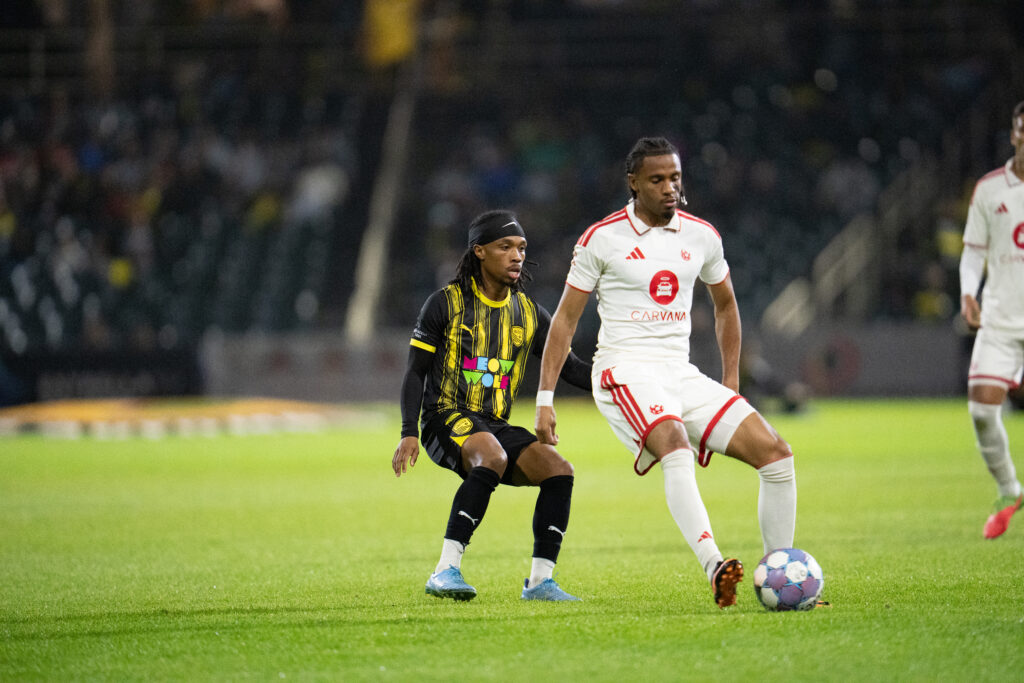
ALBUQUERQUE, N.M. — Phoenix Rising‘s season came to an abrupt end in the first round of the USL Championship playoffs as they fell 2-0 to New Mexico United on the road.
An early goal from ex-Rising man Greg Hurst put the hosts ahead, while Jake LaCava doubled their advantage shortly into the second half. Phoenix ended the match with just nine men as Jean-Eric Moursou and Gunnar Studenhofft both saw red.
Early goals cause issues
Early goals were the issue for Phoenix Rising as they conceded in the first ten minutes of each half.
Former Phoenix Rising forward Greg Hurst found the net from close range in the seventh minute. In doing so, he made himself the top goalscorer in New Mexico United history.
Then, just three minutes after the break, Jake LaCava found his first goal in black and yellow to double the advantage and prevent Rising from getting a foothold back in the match.
“I think when there’s a goal in the game, the momentum tends to change a little bit, so you have to find a way to get back on your feet,” Rising defender Luke Biasi said.
Phoenix Rising sees red… and red again
Phoenix Rising ended the match with nine men after Jean-Eric Moursou and Gunnar Studenhofft both received their marching orders from referee Muhammad Hassan.
In the 52nd minute, Moursou appeared to shove New Mexico coach Dennis Sanchez after the latter held the ball on a Rising restart. Then, in the 75th minute, Gunnar Studenhofft ran into Kris Shakes for the second time in the game, having already received a yellow for his first foul on the home keeper in the first half.
“The second one, you can go either or, because he’s already on the yellow and it’s on the goalkeeper, so that one you can live with,” Rising coach Pa-Modou Kah said. “But the first one, absolutely not.”
“In heated moments like this, in playoffs, in rivalry matches, you’ve got to keep your cool,” Biasi said. “And whether it’s officiating, weather, weather delay, people talking trash, you’ve got to keep your cool and make smart choices. I know it’s ironic coming from me.”
Owain’s take
Well, in a lot of ways, it started just as it had gone for most of the season.
As Muhammad Hassan blew the final whistle in Albuquerque, we had been treated to potentially the worst Phoenix Rising playoff performance in club history.
I don’t say that as hyperbole. Within minutes, they were behind, and while a handful of chances would follow, did you really think they were going to result in a goal?
Two-thirds of the expected goals (xG) for Rising came after the 80th minute. The kitchen sink approach late in the game produced opportunities, but even then, the team couldn’t convert.
Instead, Rising’s highlights were a pair of avoidable red cards. Regardless of your viewpoint on if the first one was fair or not, Jean-Eric Moursou did not need to put himself in that position. Then, Gunnar Studenhofft committed the exact same challenge he had previously seen yellow for, except seemingly worse the second time around.
So, now that the season is over, are there positives to take? Well, it certainly seems hard to see any.
This has been a season of regression in many ways. The club billed this as the 10th anniversary of the rebrand from Arizona United, but unfortunately it also marks the fifth straight season without Phoenix Rising hosting a playoff match.
If it weren’t for a short run at the end of the season, this squad wouldn’t have made the playoffs. In some ways, after a performance like this, you have to question if it would have been better if they hadn’t.
So what is the future for Phoenix Rising? It feels… complicated.
This week, I’ll take a look at what led the club here, and in doing so, take a look at what I’ll dub the four horsemen of Rising’s 2026 apocalypse.
First, there’s the coach. Do I think Pa-Modou Kah deserves all the blame for this season? No. Do I think replacing him alone will turn this club’s fortunes around? Not a chance. But poor discipline will always be a coach’s responsibility. Beyond that, we just haven’t seen the same result-altering in-game adjustments that he showed off in his first season, and several young players seem to have stalled in their progression. So is he the man to take this club forward beyond this year?
Then, there’s the president. Bobby Dulle has been this club’s leader since the days of the rebrand, but on its tenth anniversary, the club is facing genuine questions about the direction that it’s going in. If it weren’t for a few late-season crowds boosted by Dollar Beer Nights, this season would have seen a miserable decline in attendance, and at the same time, we hear consistently about his involvement in player recruitment while his relationship with the fanbase seems damaged beyond repair. Can he actually be the one to lead a fractured Phoenix Rising community forward?
Third is the sporting director, Brandon McCarthy. The ex-pitcher frequently faces criticism for his lack of football background, but there are genuine critiques to be had. Simply put, this team has failed to host a playoff game in each of the four seasons he’s served in his current role, while showing no sustained progression. A serious sporting director would have to answer for how this fits into a genuine project or plan. But does he?
Finally, there’s the owner. Dr Pablo Prichard is the principal owner of Phoenix Rising, but after the years before his involvement of fans feeling that they had access to ownership, Prichard has been anything but. In fact, sources around the club have suggested less and less of a presence as the years go on. Even as fans started protesting — at one point even asking the question of “where’s Pablo?” — he remains unseen. So how invested is he in the future of this club?
Those are questions for this week and the coming months. Answering them requires thoughtful reflection on where this club actually wants to be in two, five, or even ten years’ time.
For now, though, the 2026 Phoenix Rising season has come to a conclusion.
But the attention — and the scrutiny — shouldn’t be going away any time soon.
Top image: New Mexico United